
Akshatha Hegde's career has moved from medical electronics and healthcare IT to e-commerce, SaaS, fintech, and now precision measurement at Hexagon. In this conversation, she speaks about the first female executive she met, the room that taught her how unevenly credibility can be assigned, and why the kindest advice to her younger self would be to question the system before questioning her own ability.
Bio
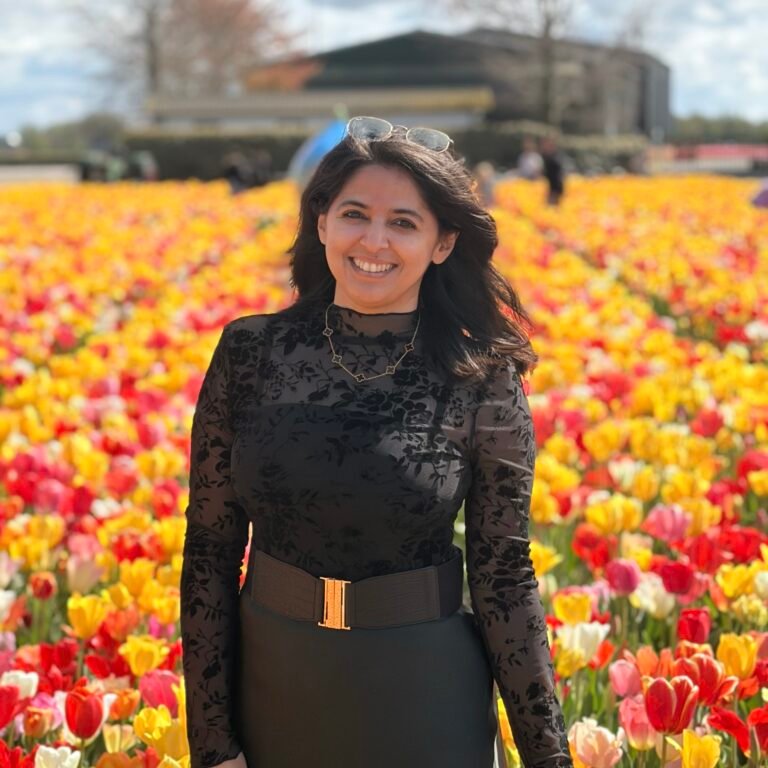
Akshatha Hegde is Director of Strategy and Analytics at Hexagon, a technology company specializing in precision measurement. Across more than 12 years, she has worked in healthcare IT, e-commerce and supply chain analytics, SaaS revenue planning and go-to-market strategy, fintech, and portfolio strategy. She studied medical electronics in India before completing an MBA in Berlin and now lives in Utrecht. The constant thread in her career is a love of data, large problems, and connecting the dots.
The Conversation
Your career has crossed healthcare, e-commerce, SaaS, fintech, and now metrology. What connects those moves?
Aks: I am originally from Bangalore. I always joke that, like many Bangaloreans, I did engineering first and then tried to figure out what I wanted to do with my life. I studied medical electronics and was very passionate about healthcare, so I spent about six years in healthcare tech.
I started close to the product, understanding how nurses and doctors used technology in their daily workflows. Gradually, I became more interested in the business side: the outcome of the product, the data behind it, and the decisions that followed. That is what led me to an MBA in Berlin.
The MBA placed me in a class of around 60 people from 35 nationalities. Until then, almost everyone around me was an engineer or came from a science background. Suddenly, I was working with people who had been chefs, artists, or financial controllers. It opened up a completely different way of thinking.
After that, I moved into supply chain analytics at Wayfair, then revenue planning and go-to-market strategy at Freshworks, followed by fintech at Pleo. Today, I am Director of Strategy and Analytics at Hexagon, where I work across a larger portfolio and look at questions such as how M&A affects revenue or how pricing affects margins.
Hexagon works in precision measurement. I describe it as building the fanciest measuring tape in the world: we measure at the micron level for industries such as automotive, aerospace, and space exploration.
The industries look very different, but the thread is consistent. I enjoy going deep into data, connecting the dots, and then stepping back to understand the bigger picture.
What keeps pulling you toward unfamiliar work?
Aks: For me, the biggest drive is self-evolution. I would not call it self-improvement. If I look back and I am the same person I was last year, I need a serious evaluation. My thinking should have evolved, my decisions should have evolved, and my relationships should have evolved.
That way of thinking comes largely from my grandfather. He taught me to work on myself, understand what matters to me, and not become too focused on the outcome.
Professionally, I am drawn to things I have not figured out yet. When business analysis was still new to me, I wanted to understand it and see whether I could excel in it. When I see a new problem, my brain immediately wants to solve it. That gives me energy because it is evidence that my thinking is still evolving.
Who helped you build the confidence to keep making those moves?
Aks: It is difficult to name one person. My husband played a very big role in helping me find my confidence. He was not only supportive; he was almost pushy. He would say, ‘Go out there. Put yourself out there. Try it, and if you fail, that is fine.’
Growing up in India, even in a large city such as Bangalore, I could see how strongly patriarchy shaped opportunity. There were many women around me with obvious ability, but they were not always given the chance to use it.
My mother was another example. At 60, she decided to pursue a PhD in philosophy and completed it. She has changed careers several times, worked in media, and is a published author. I saw closely how she navigated a very competitive, male-dominated industry.
My father is an entrepreneur, so I also grew up seeing the highs and lows of building your own business. Different people gave me different things, but my grandfather gave me the structure for how I think.
What role has representation played in your own career?
Aks: For the first seven or eight years of my career, I had never spoken face to face with a female executive. I had always been ambitious, academically and professionally, and I believed I could aim high. Still, when I finally met a woman in an executive role, a mental block shifted.
I did not expect it to affect me so strongly. Seeing and speaking to women in C-level positions changed something in my brain chemistry. It made the possibility feel real in a different way.
That is why visible examples and initiatives such as HERpower matter. We can take representation for granted, but seeing someone who makes you think, ‘I could be that person,’ can change the direction of a career.
What has challenged you most professionally?
Aks: It happened early in my career, after I had moved into business analytics. There were very few business analysts in a company of around 30,000 employees, and probably even fewer women in that role.
I walked into a meeting to present an analysis and recommendations to about 40 managers, all men. A male colleague came with me because he was new and shadowing me. He was there to learn from the presentation, but the questions and eye contact were directed to him. By default, people assumed he had more authority and more knowledge about work I had built.
Nobody said anything openly inappropriate. It was in the small things: who they looked at, who they questioned, and how often the credibility of my work was challenged. I came out of the meeting almost shaking. When 40 people question you, it becomes very easy to ask yourself whether you missed something.
My direct manager told me those managers probably knew what they were talking about and that I should check the work again. That brought me down further. But my skip-level manager had reviewed the analysis the day before. He told me he disagreed, that the work was strong, and that they should be acting on it rather than questioning whether I was credible.
He came with me to the next meeting. When the first question came, he said he had approved the analysis and stood behind every recommendation. The room went silent.
What did that experience teach you about power and allyship?
Aks: I was extremely grateful to him, and I still am. But it also hit me that it had taken a senior man to enter the room and lend me credibility.
That stayed with me. Now that I am a director, when I see someone struggling, whether that person is a woman or a man, I try to be conscious of when I can lend my privilege. A title or position gives you weight in a room, and using that weight for someone else can go a long way.
I also think differently now about how I could respond for myself. I would stop assuming that everyone else in the room was more capable than I was. I am bringing my work to the table. If I am wrong, I am ready to accept that, but tell me exactly what is wrong and what you would do differently.
Turning the question back can be powerful. Ask for the alternative. Ask what they know that you do not. Invite them to collaborate. The moment you do that, you move the conversation onto more equal ground.
What would you tell your younger self now?
Aks: Be kinder to yourself.
I’m 5 feet 3 inches tall, and I live in the Netherlands, where people are among the tallest in the world. In many houses, the kitchen counters and shelves are simply too high for me. When I go back to India, everything suddenly feels easier to reach. It made me realize that sometimes the difficulty is not you. The environment was simply not designed for someone like you.
The same can be true at work. Many structures, policies, and ways of working were not designed with women in mind. When you feel uncomfortable in that environment, it is easy to assume that you are the problem or that you lack something.
I would tell my younger self to step back and ask: Is this really about me, or is it the setup? Don’t immediately doubt your skills. Sometimes it is reasonable to question the setup.
How do you see AI changing the way people and companies work?
Aks: AI is here to stay, but right now we still talk about it as something outside the way we work: something separate that has to be integrated. I think it will soon feel as ordinary and embedded as GPS. We will use it without stopping to label the act as ‘using AI.’
I think about it in three layers: personal use and development, business productivity, and the way a company interfaces with customers. Those are different questions, and using AI simply because it is the current buzzword will not take us anywhere.
Personally, I use AI extensively to make my life easier and give myself more space to think. In business, I sometimes use it almost like another person on the team: something I can brainstorm with and something that can help finish a task.
But the vision for the team matters. How does AI make existing team members more successful? If you replace a person with AI, you may still produce the same outcome with a different resource. If you use AI to enhance human capacity, you can change the outcome: build something new, solve a different problem, or create room for innovation.
That requires humans in the loop. The focus should be on what becomes possible, not only on producing the same result at a lower cost.
After India, Berlin, and the Netherlands, where do you call home?
Aks: My parents moved from a smaller town to a larger city within India, so I grew up between different cultures before moving countries myself.
If I have to define home, it is where I have my favorite books. Of course, home is also where your favorite people are and where you can cook your favorite meal. But my books are like a warm blanket. If they are there, I feel at home.
My family is from southern India, but our ancestors migrated there from the north. So even my own background is a mix of different parts of India.
Now I live in Utrecht. One of the first things I noticed was how open the houses are to the street. The doors open directly onto it, and many windows have no curtains. In the beginning, that made me feel quite vulnerable. Now I find it liberating. Nobody is particularly interested in looking into other people’s homes. Everyone is simply relaxed about it, and I’ve come to appreciate that.
Thank you, Akshatha ! It’s been a pleasure getting to know you.
Connect with Akshatha Hegde
If you wish to connect with Akshatha Hegde and learn more, seek advice, or share similar experiences, feel free to reach out to her via LinkedIn.