
integration at scale
Integration Built for Enterprise Complexity
Data crossing company boundaries. Regulators watching. A sync failure that means an SLA breach or a security incident. Most tools weren’t designed for this. Exalate was. Full control over how data is exchanged. And security that satisfies procurement in regulated industries.
- Cloud/Data Center
- ISO 27001:2022
- GDPR
- TLS 1.3/1.2
- Single-tenant







The Problem With Most Enterprise Integrations
Usually, integration use cases seem simple: connect two systems, sync a few fields, ship it.
The real work shows up later, when how your organization operates stops matching the rules you set on day one.
You can't enforce data boundaries properly
The sync has to respect how each side works, and that gets harder when you’re connecting with an outside vendor or partner. Now you need to be exact about what crosses over: which fields are shared, which stay put, whether internal comments travel or not, etc.
Complex workflows hit template ceilings
Standard integration tools only do what their presets allow. The moment your sync has to match how your team actually works, the tool can’t follow. You lose time finding a workaround, then more time waiting on the vendor to decide if they’ll build what you need.
Change is a liability
Once it’s live, the requirements keep moving. A new condition from your team, a fresh request from the vendor, a rule that has to change. Each time, two things matter: how hard the change is to make, and whether you can tell who changed what, and when.
You can't enforce data boundaries properly
When you’re connecting with an outside vendor or partner, you need to be exact about what crosses over:
- Which fields are shared and which stay put
- Whether internal comments travel or not
- What each side can and can't see
Complex workflows hit template ceilings
Standard tools handle the common cases and stop there. When your sync has to match how your team actually works:
- The presets run out
- You lose time finding a workaround
- Then more time waiting on the vendor to build what you need
Change is a liability
Once it’s live, the requirements keep moving. Each change raises two main questions:
- How hard is it to make?
- Can you tell who changed what, and when?
You can't enforce data boundaries properly
When you’re connecting with an outside vendor or partner, you need to be exact about what crosses over:
- Which fields are shared and which stay put
- Whether internal comments travel or not
- What each side can and can't see
Complex workflows hit template ceilings
Standard tools handle the common cases and stop there. When your sync has to match how your team actually works:
- The presets run out
- You lose time finding a workaround
- Then more time waiting on the vendor to build what you need
Change is a liability
Once it’s live, the requirements keep moving. Each change raises two main questions:
- How hard is it to make?
- Can you tell who changed what, and when?
That's not failure. It's the nature of integration. But at scale, that creates three problems that don't go away:
You can't enforce data boundaries properly
When you’re connecting with an outside vendor or partner, you need to be exact about what crosses over:
- Which fields are shared and which stay put
- Whether internal comments travel or not
- What each side can and can't see
Complex workflows hit template ceilings
Standard tools handle the common cases and stop there. When your sync has to match how your team actually works:
- The presets run out
- You lose time finding a workaround
- Then more time waiting on the vendor to build what you need
Change is a liability
Once it’s live, the requirements keep moving. Each change raises two main questions:
- How hard is it to make?
- Can you tell who changed what, and when?





“

Exalate is a really good solution and the product impressed me because I had the fine-grained ability to manipulate directions, nuance field behaviors, programmatically do things… The more I got into it, the more I could do.
Carlos Almeida | VP of Engineering

Exalate works well for us. It's very much a set-and-forget solution. We get it going and it just looks after itself.
Kyle Taylor | Operations and Analytics Specialist

I was positively surprised by how Exalate satisfied our synchronization needs. We managed to reduce the monthly costs of growth's Service Desk by around 95%.
Piotr Radtke | Senior Project Manager

For us who implement and manage the connection, flexibility is the most impressive feature as we can do almost anything we want with the sync. I can say I haven't seen any other apps as flexible as Exalate.
Daniel Miks | Atlassian Solution Expert

Without Exalate, we would have had to add each developer to Salesforce to be able to track that information, which would have been a huge cost on our side.
Adrian Salaza | QA Engineer

Exalate stood out as the ideal solution due to its proven track record, reliability, and strong customer feedback, giving us confidence that we could execute the migration successfully and with minimal risk.
Thiyagarajan Anandan | Engineering Manager
How Exalate is Different
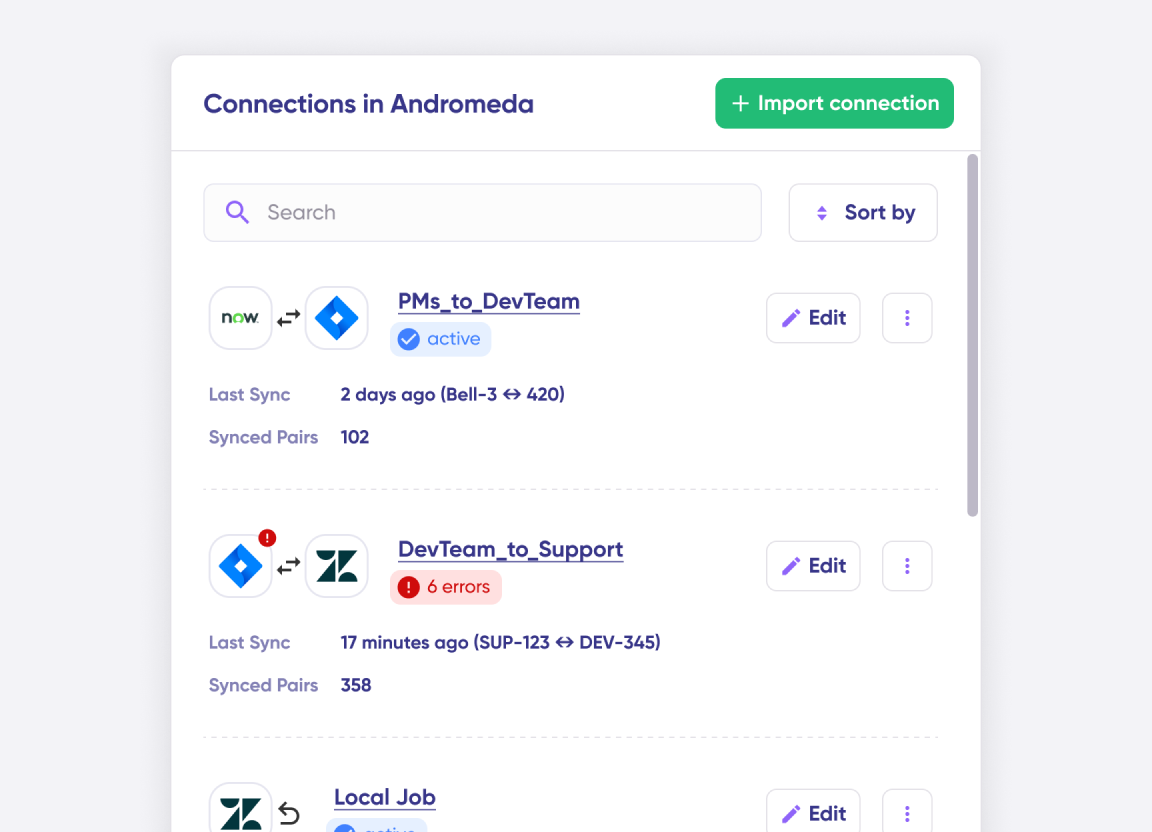
Exalate is a real-time, two-way integration solution built for flexibility: you decide what gets synced and how, with each side setting its own rules.
It’s made to handle integrations across company boundaries, with vendors and partners, with the security and precision those cases need.
Exalate is a real-time, two-way integration solution built for flexibility: you decide what gets synced and how, with each side setting its own rules.
It’s made to handle integrations across company boundaries, with vendors and partners, with the security and precision those cases need.
Each Party Controls Their Own Rules
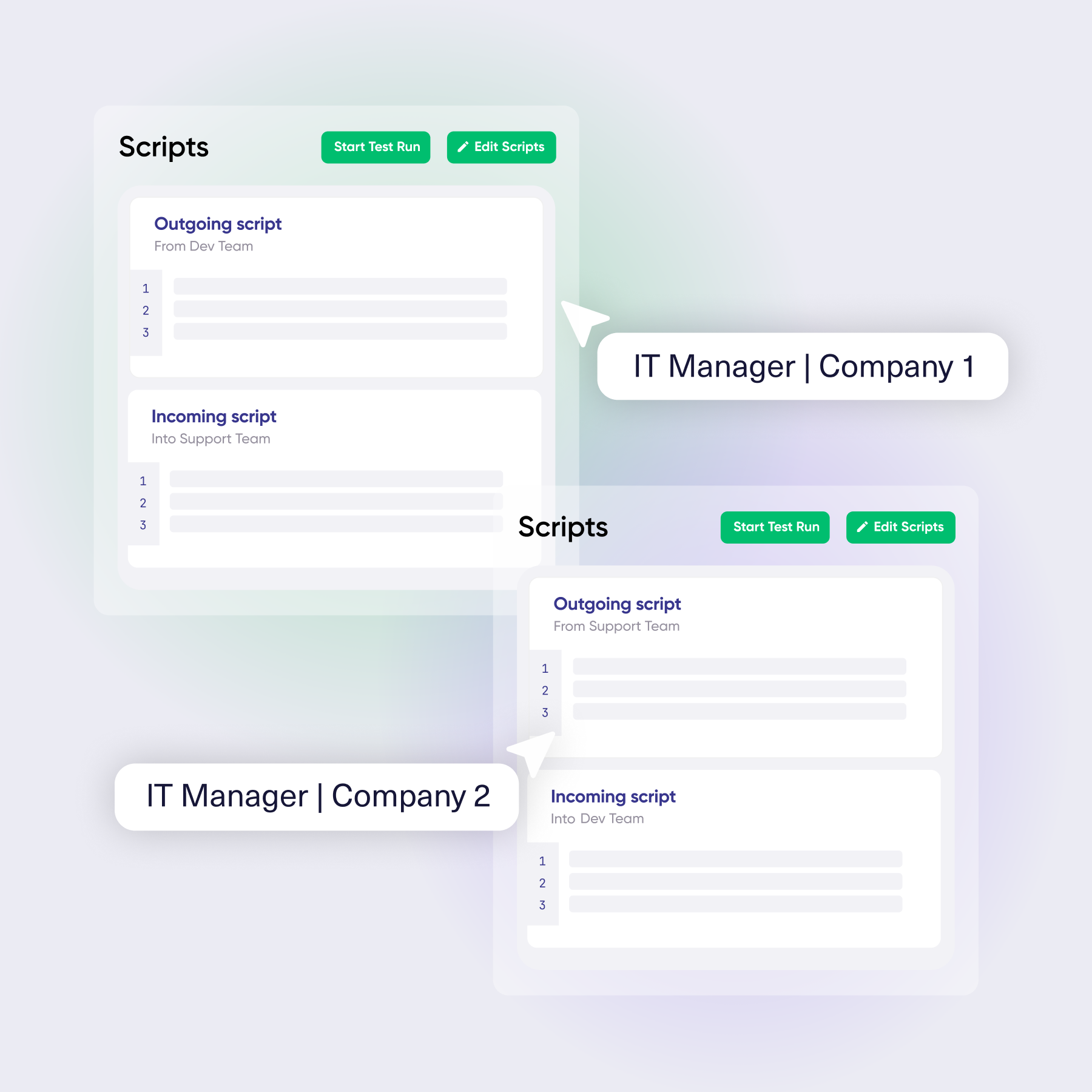
When you sync with a vendor, one side configures what leaves their system, and the other configures what they receive. Neither side sees into the other’s setup or depends on the other to make changes.

Vodafone needed to sync issues with multiple external vendors; without giving them visibility into the internal process. With Exalate, they now coordinate 20,000+ synced entries across Jira instances. Each vendor sees only what Vodafone explicitly allows.
"Exalate serves as a cornerstone for our data integrity. It guarantees that information is consistently mirrored across all connected instances."
Sync Logic Has No Ceiling
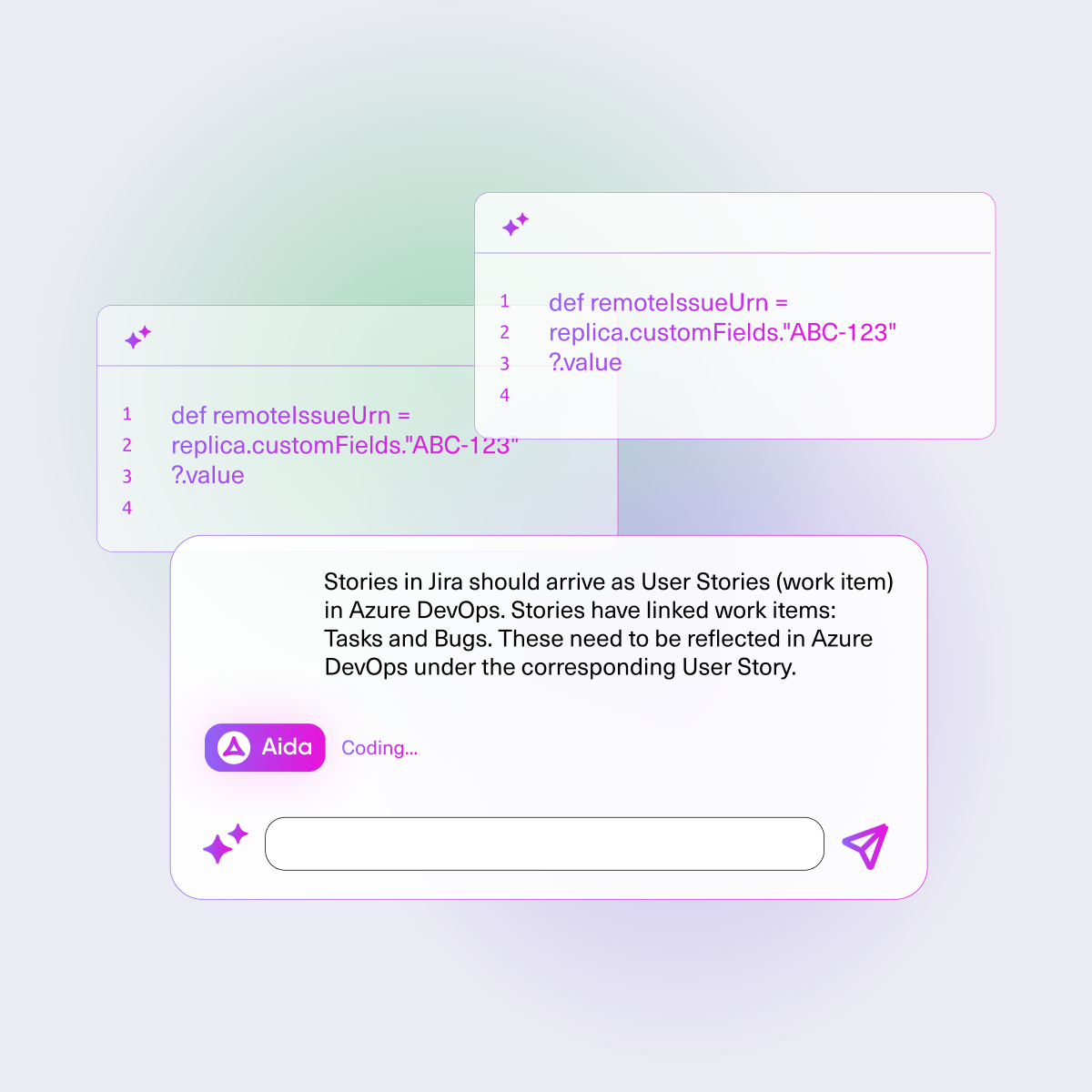
Exalate’s scripting engine handles the logic templates can’t: conditional field mapping, status transitions tied to your business rules, filtering by issue type or priority. If you can describe the logic, Exalate can run it. Rather not script it yourself? Aida, the built-in AI assistant, writes it for you.

SPK analyzed other integration solutions, and it was first attracted to the simple mapping solutions. Till they realized how it would limit them.
"Exalate impressed me because I had the fine-grained ability to manipulate directions, nuance field behaviors, and programmatically do things. The more got into it, the more could do."
You Control When Things Change
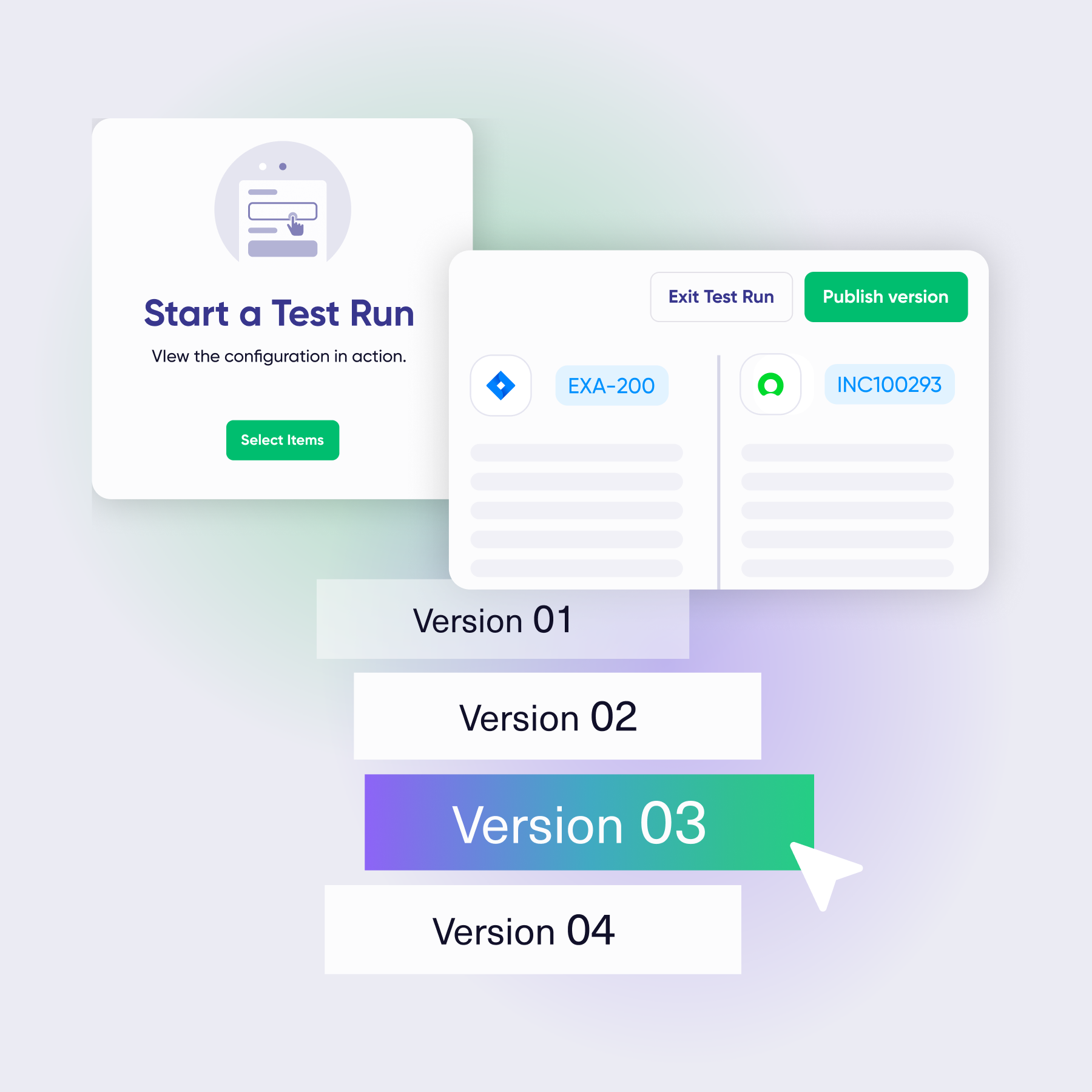
Change the sync logic, test it against real data before it goes live, and roll back if you need to. Every change is versioned. Nothing goes live by accident.

NVISO, a cybersecurity MSSP, runs Exalate as the backbone of their client integration model. Initially, they built their own integration solution, but soon the cost and complexity of maintaining it outgrew the value. So they moved to Exalate.
"We can even build our own integration on top of it, and it actually shows that the the engineers behind the product do really know what they are doing."
Scale Without the Workload
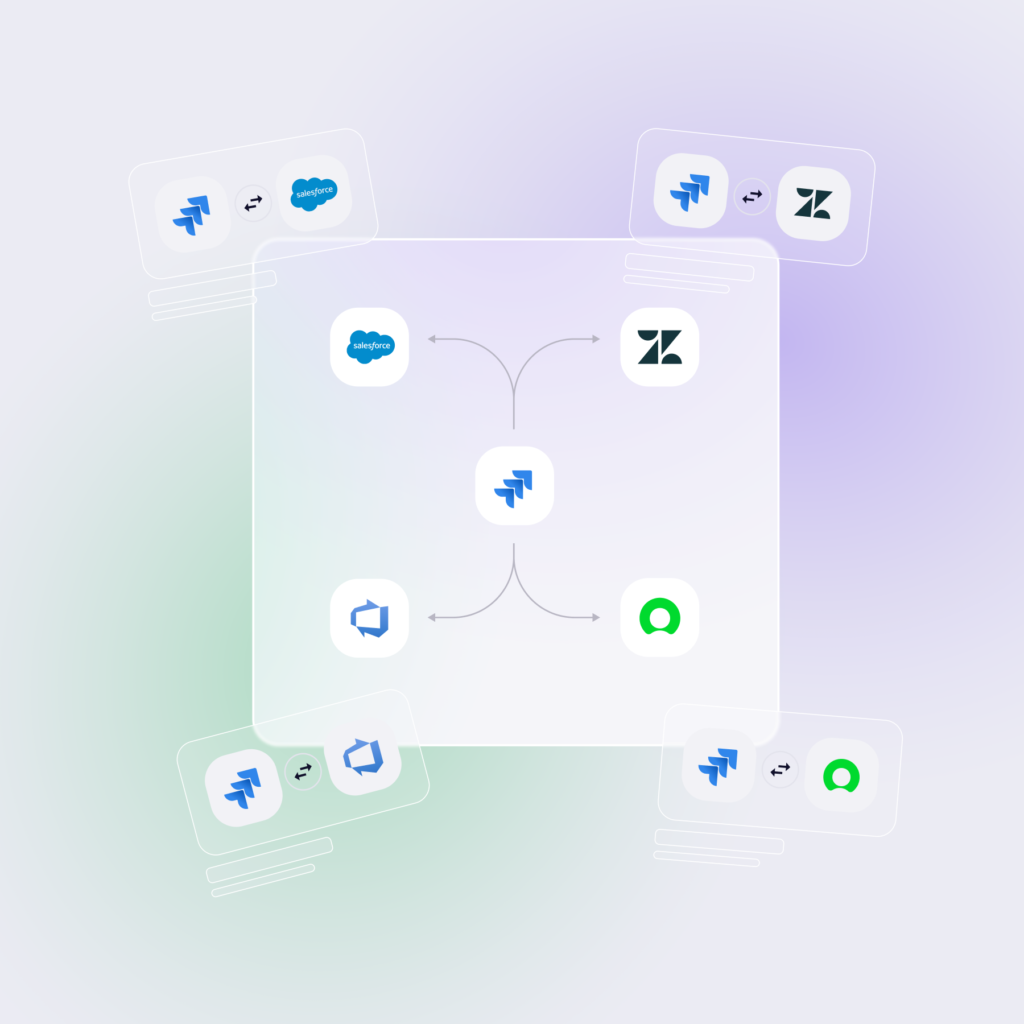
Connecting across many teams, partners, or customers? You can reuse one standard setup, or give each connection its own custom rules. Either way, scaling up doesn’t grow your workload the same way.
With the acquisition of six to eight businesses annually, migrations and integrations become essential for Ideagen. Ensuring everything is operationally efficient and meets the needs of customers and internal stakeholders. They build once, and deploy repeatedly across different tools.
"For us, it's scalable. We can bring in a new acquisitions and it's very easy to set them up. We create a new trigger or update our existing ones. We do a bulk sync and off it goes. We don't need to do much more work on that."
Each party controls their own rules
When you sync with a vendor, one side configures what leaves their system, and the other configures what they receive. Neither side sees into the other’s setup or depends on the other to make changes.

user stories
Vodafone needed to sync issues with multiple external vendors; without giving them visibility into the internal process. With Exalate, they now coordinate over 20,000 synced entries across Jira instances. Each vendor sees only what Vodafone explicitly allows.
"After thorough evaluation, we realized other solutions couldn't match Exalate's precision and flexibility." | Vodafone Germany
Sync logic has no ceiling
Exalate’s scripting engine handles the logic templates can’t: conditional field mapping, status transitions tied to your business rules, filtering by issue type or priority. If you can describe the logic, Exalate can run it. Rather not script it yourself? Aida, the built-in AI assistant, writes it for you.
user stories
Gantner handles ~500 customer incidents per week across a cross-company environment. After replacing their previous integration solution with Exalate, sync runs 45x faster. With full control over how incidents flow between their internal teams and external customers.
"We can now handle around 500 customer incidents per week, thanks to Exalate." — Gantner

Why Exalate is
Secure by Design
- Single-tenant architecture – no shared infrastructure
- Encryption in transit and at rest
- Automatic recovery from outages
- ISO 27001:2022 certified
- 24/7 threat monitoring with SentinelOne

priority support
Hands-On Assistance When The Sync Breaks
Priority Support includes dedicated support with faster SLAs, direct escalation paths, and people who already know your environment before an issue ever surfaces.
A dedicated support engineer
24/7 support for critical issues
Direct contact via Slack/Teams
Faster response times

I was positively surprised by how Exalate satisfied our synchronization needs. We managed to reduce the monthly costs of growth's Service Desk by around 95%.

Without Exalate, we would have had to add each developer to Salesforce to be able to track that information, which would have been a huge cost on our side.

When we first found Exalate, we thought, well, they’ve invented the integration wheel; it makes no sense for us to reinvent it.
How You Work With Exalate
You can run Exalate two ways
Run it yourself
Your team operates Exalate using the Enterprise plan: full scripting control, dedicated team, Priority Support, and the operational features above.
You own the configuration. We back you up.
We run it for you
Exalate Managed Services gives you a dedicated integration team that builds, monitors, and scales your integrations end-to-end. First connection live within six weeks.
You stay in control of outcomes, we handle the operational work.
What the Enterprise Plan Includes
The Enterprise plan is for organizations where integration is load-bearing: it has to work, it has to be auditable, and it has to fit your procurement process.
Unlimited active items in sync
No cap on volume. 1,000 items or 1,000,000.
The plan scales with your environment.
Priority Support with stricter SLAs
1-hour response for P1 issues.
24/7.
P2-3-4: 19h business hours per day. Monday-Friday.
Data residency
Choose where your integration data is hosted.
For regional compliance requirements.
Dedicated Support Team
A dedicated support engineer who already knows your setup and Customer Success Manager as a single point of contact across onboarding, scaling, and any changes to your environment (via direct Slack channel).
Version Pin
Pin production to a specific release.
Non-production or Sandbox environments
Test changes against production-like data before they go live.
Enterprise Performance Tiers
Scale memory and processing for heavy scripting workloads, high-frequency syncs, or bulk migrations.
Multi-integration pricing
Connect multiple systems or syncing across a large network. Pricing built for that, not against it.
What the Enterprise Plan Includes
The Enterprise plan is for organizations where integration is load-bearing: it has to work, it has to be auditable, and it has to fit your procurement process.
Unlimited active items in sync
No cap on volume. 1,000 items or 1,000,000.
The plan scales with your environment.
Priority Support with stricter SLAs
1-hour response for P1 issues.
24/7.
P2-3-4: 19h business hours per day, Monday-Friday
Data residency
Choose where your integration data is hosted.
For regional compliance requirements.
Dedicated Support Team
A dedicated support engineer who already knows your setup and Customer Success Manager as a single point of contact across onboarding, scaling, and any changes to your environment (via direct Slack channel).
Version Pin
Non-production or Sandbox environments
Test changes against production-like data before they go live.
Enterprise Performance Tiers
Scale memory and processing for heavy scripting workloads, high-frequency syncs, or bulk migrations.
Multi-integration pricing
Connect multiple systems or syncing across a large network. Pricing built for that, not against it.
Every integration environment is different. Tell us yours.
Book a 30-minute call with someone who works with enterprise integration environments every day. We’ll map your setup and walk through how Exalate fits.
FAQ
Answers to the most frequent questions.
Didn't find what you were looking for? Ask Aida
The Enterprise plan removes scaling limits and adds the operational layer organizations need at scale: unlimited active items in sync, data residency options, defined SLAs through Priority Support, a dedicated CSM and support engineer, sandbox environments, and multi-integration pricing tailored to your setup.
The Enterprise plan includes multi-integration pricing tailored to your environment. Whether you’re connecting two systems or twenty, pricing is based on your actual setup and the integrations you need.