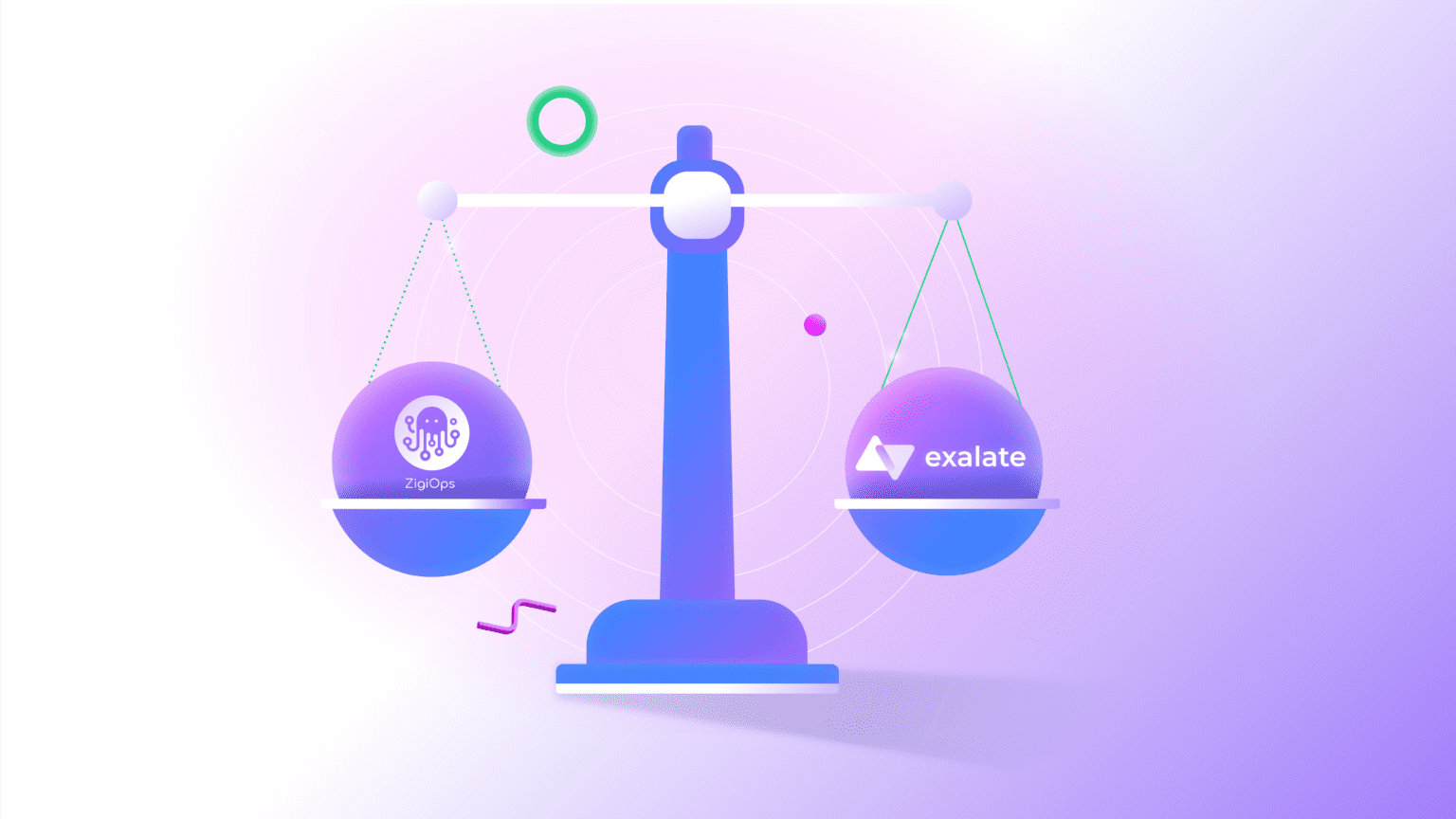
Organizations using multiple work management systems like Jira, ServiceNow, or Salesforce need reliable ways to share data without compromising security or losing critical information. ZigiOps and Exalate are two integration solutions designed to solve this problem, but they take different approaches.
This comparison breaks down how each tool handles security, customization, pricing, and platform support so you can determine which fits your specific integration needs.
Quick Comparison Table
| Feature | ZigiOps | Exalate |
|---|---|---|
| Configuration Approach | No-code templates only | Groovy scripting with AI-assisted configuration |
| Setup | Single installation for all systems | No installation required. Register, connect systems, configure rules, set triggers |
| Customizability | Limited to pre-built templates | Unlimited via Groovy scripting engine |
| AI Features | AI Chatbot is an integration consultant giving instant answers | Aida for sync script generation and error diagnosis |
| Sync Direction | Bi-directional | Bi-directional with independent control per side |
| Pricing Model | System pairs (contact for quote) | Outcome-based (active items in sync) |
| Free Trial | Yes | Yes (30 days) |
| ISO 27001 | Yes | Yes (2022 certified) |
| Supported Platforms | 30+ (monitoring-heavy) | 15+ (ITSM and DevOps focused) |
| Test Before Deploy | No | Yes (Test Run functionality) |
| Sync Script Versioning | No | Yes (with rollback) |
Key Takeaways
Exalate is best for teams that need deep customization and script-based control over complex, cross-company integrations. Its Groovy scripting engine handles workflows that template-based tools cannot support.
ZigiOps is best for organizations that want quick, template-based integrations without writing code, especially for monitoring and observability tool connections.
Choose Exalate if you need: custom field mappings, cross-company collaboration with independent control, script versioning, or AI-assisted script generation.
Choose ZigiOps if you need: fast deployment using pre-built templates, monitoring tool integrations (Dynatrace, Datadog, Splunk), or prefer not to work with code.
What is ZigiOps?
ZigiOps is a no-code integration platform built by ZigiWave that connects ITSM, monitoring, DevOps, and CRM systems. The platform uses pre-built templates to configure integrations through a web-based interface without writing code.
ZigiOps supports both cloud and on-premises deployment. It processes data in transit only and does not permanently store customer data, which simplifies compliance requirements.
Recent updates include an AI Assistant for troubleshooting integration errors and MCP (Model Context Protocol) support for connecting to AI models.
What is Exalate?
Exalate is a flexible integration solution that syncs data between work management platforms using a Groovy-based scripting engine. This approach gives teams full control over what data syncs, when it syncs, and how it transforms between systems.
Getting started with Exalate is straightforward. Register your account at exalate.app, connect your two systems by entering and verifying each URL, naming your connection, and start configuring sync rules. The unified console lets you manage all integrations from a single place.
Exalate supports platforms including Jira, ServiceNow, Salesforce, Azure DevOps (Cloud and Server), Zendesk, GitHub, Freshdesk, Freshservice, and Asana. Early Access connectors are available for additional platforms like TOPdesk, ServiceDesk Plus, Ivanti, ConnectWise, Xurrent, HaloITSM, and SolarWinds.
ZigiOps vs. Exalate: Feature Comparison
Security
Both solutions prioritize data protection but implement it differently.
ZigiOps uses 256-bit AES/CBC encryption, TLS 1.3/1.2, SFTP, and FTPS. The cloud version is accessible only via HTTPS and uses OAuth for authentication with a Java Keystore for certificate management. ZigiOps processes data in transit without permanent storage.
Exalate secures all data transmission via HTTPS with encryption at rest and in transit. It uses JWT tokens and OAuth for authentication and holds ISO 27001:2022 certification. Exalate uses SentinelOne for endpoint detection and response to address security incidents. Role-based access control lets administrators grant integration management access without exposing system credentials.
For complete security documentation, visit Exalate’s Trust Center.
Verdict: Exalate has a slight edge with ISO 27001:2022 certification, advanced EDR with SentinelOne, and role-based access controls.
Data Residency and Privacy
Exalate Cloud uses Google Cloud’s data center in Belgium, with backups stored in Switzerland via Rsync.net offline data center.
ZigiOps uses AWS infrastructure and does not store data in a database except for troubleshooting purposes. Users control what data stays in storage.
Verdict: Draw. Both solutions prioritize data privacy with different infrastructure approaches.
Licensing and Compliance
ZigiOps holds ISO 27001 and FIPS 140-2 certifications.
Exalate holds ISO 27001:2022 certification. Since the company headquarters is in Belgium, the solution is GDPR-compliant.
Verdict: Tie. Both maintain industry-standard compliance certifications.
User Experience and Setup
ZigiOps positions itself as a no-code platform with pre-built templates accessible through the ZigiOps Web Console (Chrome and Edge only). The platform requires specific software and hardware requirements before installation.
Exalate offers a streamlined setup process through its unified console. Register at exalate.app, enter and verify your source system URL, enter and verify your destination URL, name your connection, and begin configuring sync rules. The console provides a side-by-side view of script rules, active queues, and errors for both sides of your connection.
Verdict: ZigiOps templates speed initial setup, but Exalate’s unified console and simpler onboarding reduce ongoing management overhead.
Speed and Performance
Both platforms support real-time, instant synchronization using triggers for automatic updates.
ZigiOps performance depends on the deployment server configuration.
Exalate provides complete sync queue visibility with the ability to filter by connection name or entity ID and view processing status.
Verdict: Similar real-time capabilities. Exalate offers better visibility into sync operations.
Customizability
This is where the tools diverge significantly.
ZigiOps relies entirely on pre-built templates and visual configuration. While templates cover common use cases, they cannot handle complex conditional logic or custom field transformations that fall outside the template parameters.
Exalate uses a Groovy-based scripting engine that handles any custom workflow. If you can write it in Groovy, Exalate can sync it. You control incoming and outgoing sync logic independently on each side of the connection.
Exalate includes Aida, an AI assistant that helps generate Groovy code snippets and mappings for complex use cases. Aida also explains errors in plain language and suggests context-aware resolutions. This reduces the time needed to write scripts from scratch and speeds up troubleshooting.
Verdict: Exalate wins for customization. Script-based configuration handles use cases that template-based tools cannot support.
Operational Control
ZigiOps manages integrations through its web console with an interactive dashboard for monitoring connection health and license usage.
Exalate provides unified visibility and management across all connections from a single console. Key features include:
- Network visualization showing how systems interconnect across your integration environment
- Script versioning that creates a new version each time you publish changes, with the ability to roll back to previous versions
- Test Run functionality that lets you test sync scripts without creating actual entities on the destination system
- Side-by-side view for working with both sides of a connection on a single screen
Verdict: Exalate provides stronger operational control with versioning, rollback, and Test Run capabilities.
Cross-Company Collaboration
ZigiOps manages integrations centrally, meaning the admin has visibility into data from connected systems.
Exalate is designed for cross-company integrations where each organization needs independent control. Each side manages its own sync rules and data mappings while the unified console provides visibility across all connections.
Verdict: Exalate is purpose-built for cross-company scenarios requiring independent control over sync rules.
Connectivity and Supported Platforms
ZigiOps supports 30+ platforms with strength in monitoring and observability tools:
- ServiceNow
- Jira Cloud
- Azure DevOps
- Salesforce
- BMC Helix/Remedy
- Dynatrace
- Datadog
- Splunk
- Micro Focus OpsBridge
- AppDynamics
- New Relic
- Prometheus
- Kubernetes
Exalate focuses on ITSM, DevOps, and collaboration platforms:
- Jira
- ServiceNow
- Salesforce
- Azure DevOps (Cloud and Server)
- Zendesk
- GitHub
- Freshdesk
- Freshservice
- Asana
Additional connectors available: TOPdesk, ServiceDesk Plus, Ivanti, ConnectWise, Xurrent, HaloITSM, SolarWinds. Custom connectors can be requested by contacting the team.
Verdict: ZigiOps supports more monitoring tools. Exalate offers deeper integrations for ITSM and DevOps platforms with more flexibility in how data syncs.
Pricing
ZigiOps pricing is not publicly available. The model is based on system pairs. Contact ZigiWave for a custom quote.
Exalate uses outcome-based pricing where you pay based on active items currently in sync, not transactions or API calls. If you sync 50 work items between Jira and ServiceNow, you pay for those 50 items regardless of how many updates occur.
Exalate offers four plans: Trial (free 30 days), Starter, Scale, Pro, and Enterprise. Each integration can use a different plan based on complexity and volume needs.
Use the pricing calculator to estimate costs for your specific use case. View full pricing details on the pricing page.
Verdict: Exalate offers transparent, predictable pricing based on actual sync volume.
Customer Support
ZigiOps provides 20 hours of free support. Response availability may vary outside business hours.
Exalate offers 15 hours of standard support. Priority Support includes onboarding calls, solution assistance, bi-weekly syncs, and 24/7 availability with faster response times.
For hands-off integration management, explore Exalate Managed Services.
Verdict: Both offer support portals. Exalate’s Priority Support and Managed Services options provide more comprehensive coverage.
Error Handling and Troubleshooting
ZigiOps requires manual review of activity logs to identify sync issues. The new AI Assistant helps diagnose errors.
Exalate console notifications point to specific error lines in scripts, making debugging faster. Aida provides context-aware error explanations and resolution suggestions. The activity dashboard gives complete visibility into sync operations across all connections.
Verdict: Exalate’s error handling with Aida and line-specific notifications speeds troubleshooting.
Documentation and Community
ZigiOps offers case studies, white papers, blog posts, videos, and FAQs. Documentation focuses on core functionality.
Exalate provides comprehensive documentation covering all integration scenarios. Resources include:
- Documentation portal with step-by-step guides
- Exalate video tutorials
- Community forum with active users sharing solutions
- Case studies and use case examples
Verdict: Exalate offers more extensive documentation and an active community.
Final Scorecard
| Category | Winner |
|---|---|
| Security | Exalate |
| Data Residency | Draw |
| Licensing/Compliance | Draw |
| User Experience | Draw |
| Speed/Performance | Draw |
| Customizability | Exalate |
| Operational Control | Exalate |
| Cross-Company Collaboration | Exalate |
| Supported Platforms | ZigiOps |
| Pricing Transparency | Exalate |
| Customer Support | Exalate |
| Error Handling | Exalate |
| Documentation/Community | Exalate |
Who Should Use Each Tool?
Exalate is Best For:
- Teams needing custom field mappings and conditional sync logic
- Cross-company integrations requiring independent control on each side
- Organizations with complex ITSM workflows between Jira, ServiceNow, Salesforce, or Azure DevOps
- Teams wanting AI-assisted script generation and troubleshooting
- Scenarios requiring script versioning and a test run before production deployment
Exalate is Not For:
- Teams that only need simple, one-way data pushes with no customization
- Organizations looking primarily for monitoring tool integrations (Dynatrace, Datadog, Splunk)
- Users who want zero exposure to scripting concepts
ZigiOps is Best For:
- Organizations prioritizing fast, template-based setup without code
- Teams needing monitoring and observability tool integrations
- Use cases that fit within pre-built template parameters
- Companies wanting a single installation point for all integrations
ZigiOps is Not For:
- Complex intra or cross-company scenarios requiring independent control
- Teams needing custom field transformations beyond template capabilities
- Organizations wanting test environments before production deployment
Conclusion
Both ZigiOps and Exalate solve the integration challenge, but they serve different needs.
ZigiOps works well for teams wanting quick, template-based integrations, especially for monitoring tools like Dynatrace, Datadog, and Splunk. Its no-code approach speeds initial deployment.
Exalate is the stronger choice for complex, cross-company integrations where customization and independent control matter. The Groovy scripting engine handles use cases that template-based tools cannot support, and features like Aida, Test Run, and script versioning reduce risk while speeding implementation.
For organizations syncing data between Jira, ServiceNow, Salesforce, Azure DevOps, Zendesk, GitHub, Freshdesk, Freshservice, or Asana, Exalate offers deeper integration capabilities with transparent, outcome-based pricing.

Ready to see how Exalate handles your integration requirements? Start a free 30-day trial to test your specific use case.
FAQs
What is the main difference between ZigiOps and Exalate?
ZigiOps is a no-code platform using pre-built templates for quick deployment. Exalate uses a Groovy scripting engine for unlimited customization. ZigiOps works best for template-fit scenarios; Exalate handles complex use cases requiring custom logic.
How does Exalate pricing work?
Exalate uses outcome-based pricing. You pay based on active items currently in sync, not transactions or API calls. If you sync 100 issues between Jira and ServiceNow, you pay for those 100 items regardless of update frequency. Use the pricing calculator to estimate costs, or view plans on the pricing page.
Does Exalate require installation on both systems?
No. With Exalate, you register at exalate.app, connect your systems by verifying each URL, name your connection, and start configuring sync rules. The unified console manages all integrations from a single place.
What AI features does Exalate offer?
Exalate includes Aida, an AI assistant that helps generate Groovy scripts for complex sync scenarios, explains errors in plain language, and suggests context-aware resolutions. Aida reduces the time spent writing scripts and speeds troubleshooting.
Can I test integrations before deploying to production?
Exalate includes Test Run functionality that lets you test sync scripts without creating actual entities on the destination system. Combined with script versioning and rollback, this reduces the risk of errors affecting live data. ZigiOps does not offer equivalent testing capabilities.
How secure is Exalate?
Exalate holds ISO 27001:2022 certification, uses encryption for data both in transit and at rest, implements role-based access control, and uses SentinelOne for endpoint detection and response. Visit the Trust Center for complete security documentation.
What platforms does Exalate support?
Exalate supports Jira Cloud, ServiceNow, Salesforce, Azure DevOps (Cloud and Server), Zendesk, GitHub, Freshdesk, Freshservice, and Asana. Additional connectors include TOPdesk, ServiceDesk Plus, Ivanti, ConnectWise, Xurrent, HaloITSM, and SolarWinds. Custom connector development is available for Enterprise plans.
Does Exalate offer managed services?
Yes. For teams wanting hands-off integration management, Exalate Managed Services provides expert setup, monitoring, and ongoing maintenance.
How do I get started with Exalate?
Start a free 30-day trial with all features and connectors. Register your account, connect your systems, configure sync rules, and set up triggers.
Recommended Reads:
- Exalate or Getint: An Objective Comparison to Help You Choose the Best Integration Solution
- TFS4JIRA vs. Exalate: The Complete Comparison
- ServiceNow IntegrationHub or Exalate: How do they compare?
- The Best MuleSoft Alternatives for Business Process Integration
- The Best Workato Alternatives For Scalable Business Integrations
- B2B Integration: The Comprehensive Guide
- SaaS Integration Challenges and Benefits
- The Comprehensive Guide to iPaas (Integration Platform as a Service)