
Exalate marks 15 years with 26% YoY revenue growth and a widening enterprise footprint at the exact moment AI agents make ungoverned integration a live operational risk.
Fifteen years ago, enterprise software was already fragmenting how work moved across tools, teams, and companies. The problem was easy to underestimate because it usually sat between systems, not inside them.
A ticket had to move. A status had to update. A support team needed engineering context. A vendor needed enough information to act, but not enough to see everything. A company in migration needed old and new systems to run side by side without stopping work.
That space between tools became Exalate’s work.
Not the loudest layer of enterprise software. Not always the easiest to explain. But over a decade and a half, it has become one of the layers companies can least afford to misunderstand.
The problem that doesn’t sit inside any single system
From the outside, integration can look simple. Connect one tool to another. Move the data. Keep it running.
Integrations don’t just move data. They carry the context decisions depend on: how teams collaborate, where ownership sits, and what happens when one side of a bridge changes before the other is ready.
That ‘invisible layer’ has become one of the most consequential parts of enterprise software because multi-party workflows and autonomous AI tools have exponentially raised the cost of integration failure.
When integrations fail, service commitments are missed, resolution costs rise, vendor workflows break down, migrations stall.
AI is exposing integration deficiencies faster. Incomplete context, inconsistent data, or weak sync logic can spread across systems before teams have time to intervene. What used to look like a technical delay can now become a financial, operational, and governance risk.
We have spent 15 years sitting with that complexity. Our journey has not been defined by one sudden breakthrough but by the discipline to keep learning from customers who brought us use cases we had not yet imagined.
From a practical problem to a long-term product
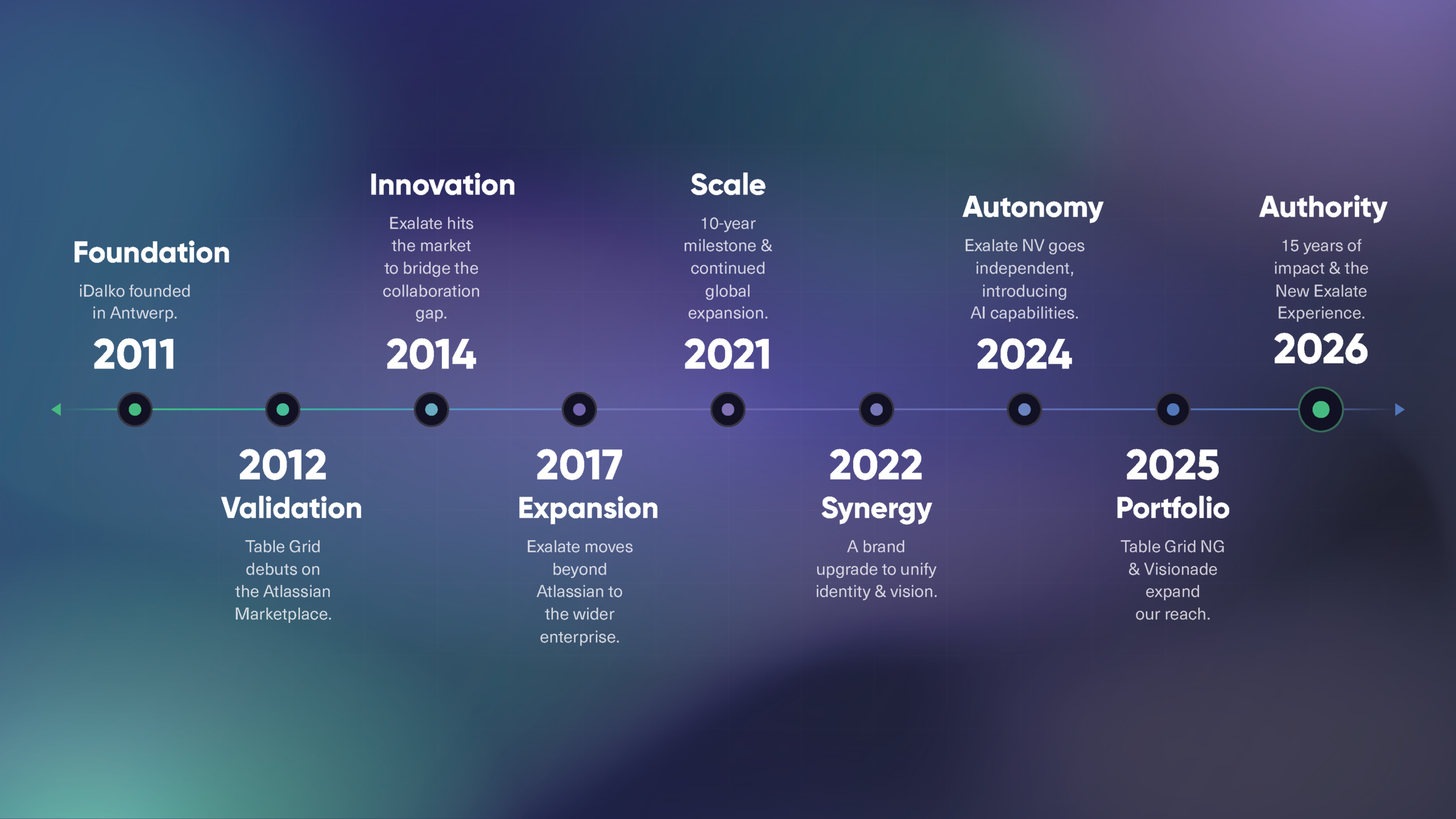
Exalate’s journey began in 2011 with iDalko, in the heart of the Atlassian ecosystem, close to the practical problems teams were trying to solve. That early work revealed something that would later shape Exalate as a product: collaboration breaks down when work is spread across tools, so we built a way to bridge that gap.
“One of the users who brought us those early Jira-to-Jira integration challenges eventually joined Exalate years later and is today our product manager”, says Francis Martens, CEO and co-founder of Exalate. “That tells you something about how the problem evolves. What started as a technical fix became a structural necessity, and today it’s mission-critical infrastructure for the enterprises running on it. We’ve been building it for over a decade, and the work is still moving forward.”
The need quickly proved bigger than connecting two tools. The need for reliable, secure alignment: keeping different systems, workflows, and organizations in sync without forcing every side into the same operating model.
A support team and an engineering team may need to collaborate on the same issue, but they do not work from the same context. A customer and a vendor may need to share progress, but not expose everything behind it. An MSP may manage dozens of client environments, each with its own rules, permissions, and obligations.
The common thread was not simply connectivity. It was data consistency, control, and the trust teams need when work crosses system and company boundaries.
For Exalate, that means a specific product principle: each side of an integration keeps control over its own data, configuration, security rules, and business logic. Integration must support collaboration without blurring ownership.
That principle has only become more important. SaaS ecosystems are larger. Cross-company workflows are part of daily operations. Companies are under pressure to automate more work but also to prove that access, permissions, and governance remain controlled.
The original practical problem grew into a broader mission: to make collaboration easier across teams and company borders through secure, scalable, and now AI-assisted integration infrastructure.
From product evolution to product responsibility
For most of integration’s history, the cost of getting it wrong was a delay. A broken sync, a stalled ticket, a workflow that needed manual intervention.
That’s no longer the floor.
AI is changing how teams describe work, configure systems, and troubleshoot problems. In integration, that matters. A setup that once required deep scripting knowledge can now start from a plain-language description. A failure that once required manual investigation can be explained faster. A workflow can be mapped more quickly.
That is the promise. But integration has always been a space where speed alone is not enough.
The lessons behind Exalate’s growth are now being carried into the product experience itself. The new Exalate experience keeps the power of Exalate’s engine while giving teams more visibility, testing, versioning, and control over how integrations are built and managed.
Aida, Exalate’s AI-assisted capability, is part of that evolution. It helps teams turn plain-language intent into sync logic, troubleshoot failures faster, and validate changes before they affect live workflows.
This is what AI-ready integration means for Exalate: we’re not handing the wheel to the machine. We are using AI to make integrations easier to build, visualize, and test, while keeping human review, local rules, and accountability in place.
“Exalate has grown from a Jira-to-Jira connector into a trusted bridge across ServiceNow, Azure DevOps, Salesforce, GitHub, and beyond,” says Francis Martens. “But more importantly, we’ve scaled our security posture to meet the demands of large enterprise environments. We’ve navigated GDPR, data residency, and increasingly complex cross-company workflows. As AI agents enter the picture, our experience in handling security and data residency matters more than ever. The current shift demands faster integration without weaker governance. We are built for that balance.”
With Aida, we’re bringing AI into the integration workflow in practical ways, ensuring that logic still needs review and accountability remains visible.
In integration, speed only matters if the result can be trusted.
“Every company that tells us Exalate has become business-critical for them — that’s the measure I come back to,” says Hilde Van Brempt, co-founder and CFO of Exalate. “Integration is ultimately about trust.”
Complex Integrations Made Possible
Fifteen years is a lifetime in technology. Long enough to see markets change, platforms rise, customer needs evolve, and assumptions get tested.
It’s also long enough to understand that reliable software isn’t built through one big idea alone. It’s built through thousands of conversations, hard use cases, product decisions, customer lessons, partner collaborations, and people who keep improving the work.
Our progress is a credit to the early adopters, customers, partners, and team members who helped shape Exalate along the way.
This milestone belongs to the work, not to the calendar.
It also brings our long-term vision into clearer view: a worldwide network of connected companies, where organizations can collaborate across tools, teams, and company boundaries without giving up control over their own data, rules, and responsibilities.
After 15 years of solving demanding integration problems, Exalate enters its next chapter with the same focus: making even the most complex integrations possible.
Beyond Sync: The Exalate NV Product Ecosystem
Exalate spent 15 years learning how enterprise work moves across tools. That experience now shows up in three product directions: keeping work synchronized, structuring work data, and making that data visible.
| Table Grid | Visionade |
| Manage structured data, dependencies, assets, orders, invoices, and operational records inside Jira | Refresh your data story in Jira. |
|
|
| Table Grid Next Generation | Visionade |
Team Exalate is ready for your toughest integration case. Let’s put this expertise to work. Reach out.