
Script-based solutions remain the go-to choice for Jira ServiceNow integration because of their flexibility and customization options.
But extended scripting capability comes with challenges: time spent generating scripts, and the stress of testing every snippet for every use case.
AI-assisted configuration changes this equation. Instead of writing scripts from scratch, you describe what you want to achieve, and the AI generates the configuration code.
This guide covers practical use cases for AI-powered Jira ServiceNow integration, the benefits and limitations you should know about, and how to implement it effectively.
Note: Jira now refers to issues as work items. This guide uses the updated terminology throughout.
Key Takeaways
- AI-assisted configuration generates Groovy scripts from natural language prompts, reducing setup time from hours to minutes for complex sync scenarios.
- Common use cases include syncing priorities, statuses, SLA records, work notes, and agile properties between Jira and ServiceNow.
- Aida (Exalate’s AI assistant) works directly within the scripting console, considering your existing sync rules when suggesting configurations.
- AI-generated scripts require human review, so always validate output before deploying to production.
- Exalate supports integrations beyond Jira-ServiceNow, including Azure DevOps, Azure DevOps Server, Salesforce, Zendesk, GitHub, Freshservice, Freshdesk, and Asana.
- When working within existing sync rules, AI considers what’s already configured. Suggestions complement rather than conflict with established mappings.

What is AI-Powered Jira ServiceNow Integration?
AI-powered Jira ServiceNow integration uses natural language prompts to generate configuration scripts. Describe what you want to achieve, and the AI produces working code.
The process works like this:
- You enter a prompt describing your sync requirement in plain language.
- The AI analyzes context, including your existing sync rules and field mappings.
- It searches relevant documentation and API specifications.
- It generates a Groovy script matching your requirements.
The more specific your prompt, the more accurate the output. Generic prompts produce generic scripts; detailed prompts with field names, conditions, and edge cases produce production-ready configurations.
Benefits of AI-Assisted Jira ServiceNow Integration
- Faster configuration: AI generates scripts in seconds that would take hours to write manually. Complex field mappings, conditional logic, and error handling appear instantly.
- Reduced expertise barrier: Administrators without deep Groovy knowledge can implement sophisticated integrations. Describe requirements in plain language; AI handles the syntax.
- Accurate data mapping: AI references current API documentation and field specifications. It identifies correct endpoints, headers, and data types automatically.
- Context-aware suggestions: When working within existing sync rules, AI considers what’s already configured. Suggestions complement rather than conflict with established mappings.
- Rapid troubleshooting: When syncs fail, describe the error to AI for diagnostic suggestions and fix recommendations.
Limitations and Considerations
- AI can hallucinate: Generated scripts may contain errors, especially for edge cases or unusual field types. Always review output before deployment.
- Prompt quality matters: Vague prompts produce generic scripts. Specify field names, data types, conditions, and expected behavior for accurate results.
- Security and compliance: Ensure your AI-assisted integration tool isolates client data appropriately. Exalate maintains ISO 27001 certification and encrypts data in transit and at rest. Review the Exalate Trust Center for detailed security documentation.
- Internet dependency: AI features require connectivity. Offline scripting falls back to manual methods.
- Human review required: Treat AI output as a draft. Test configurations in development environments before production deployment.
This tutorial demonstrates how to integrate Jira and ServiceNow using Exalate.
Go to the Exalate app. If you already have an account, you can log in directly.
New users can create an account by manually entering their email and verifying it, or by signing up using Google.
Creating a Workspace
Workspaces help you organize and manage your integrations and connections in a single place. You can find all your existing workspaces under the “Workspaces” tab.
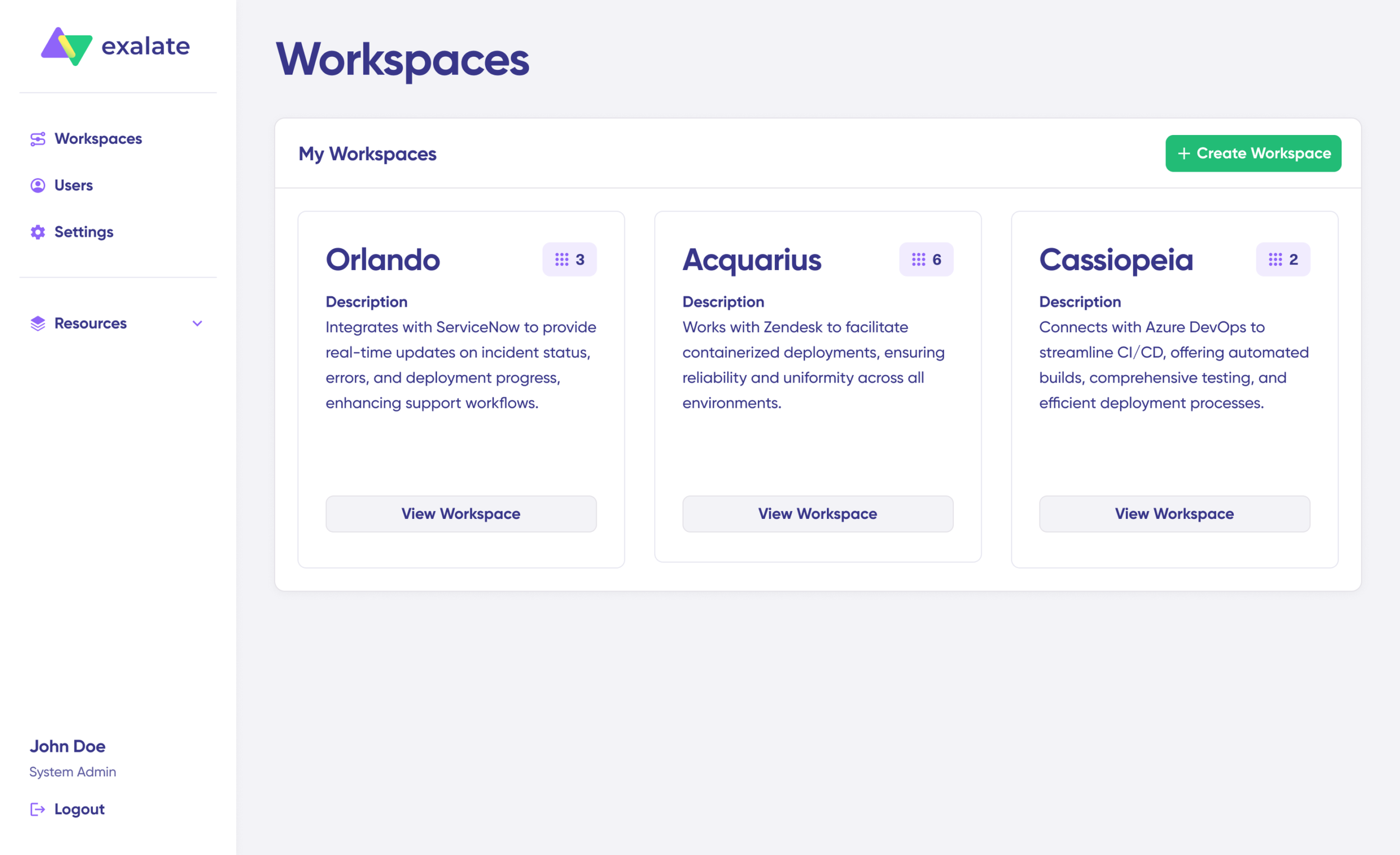
To create your first workspace:
- Click the “+ Create Workspace” button.
- Enter a name and description for your workspace.
- Click “Create workspace” to confirm.
Creating Your First Connection
Once you have a workspace, you can start creating connections between Jira and ServiceNow. If you already have an existing workspace, you can view all your connections under the “Connections” tab, where you can edit connection settings and view other connection details.
Note: To create a connection, you’ll need an active Exalate account with at least one workspace and the access credentials for the systems you want to connect.
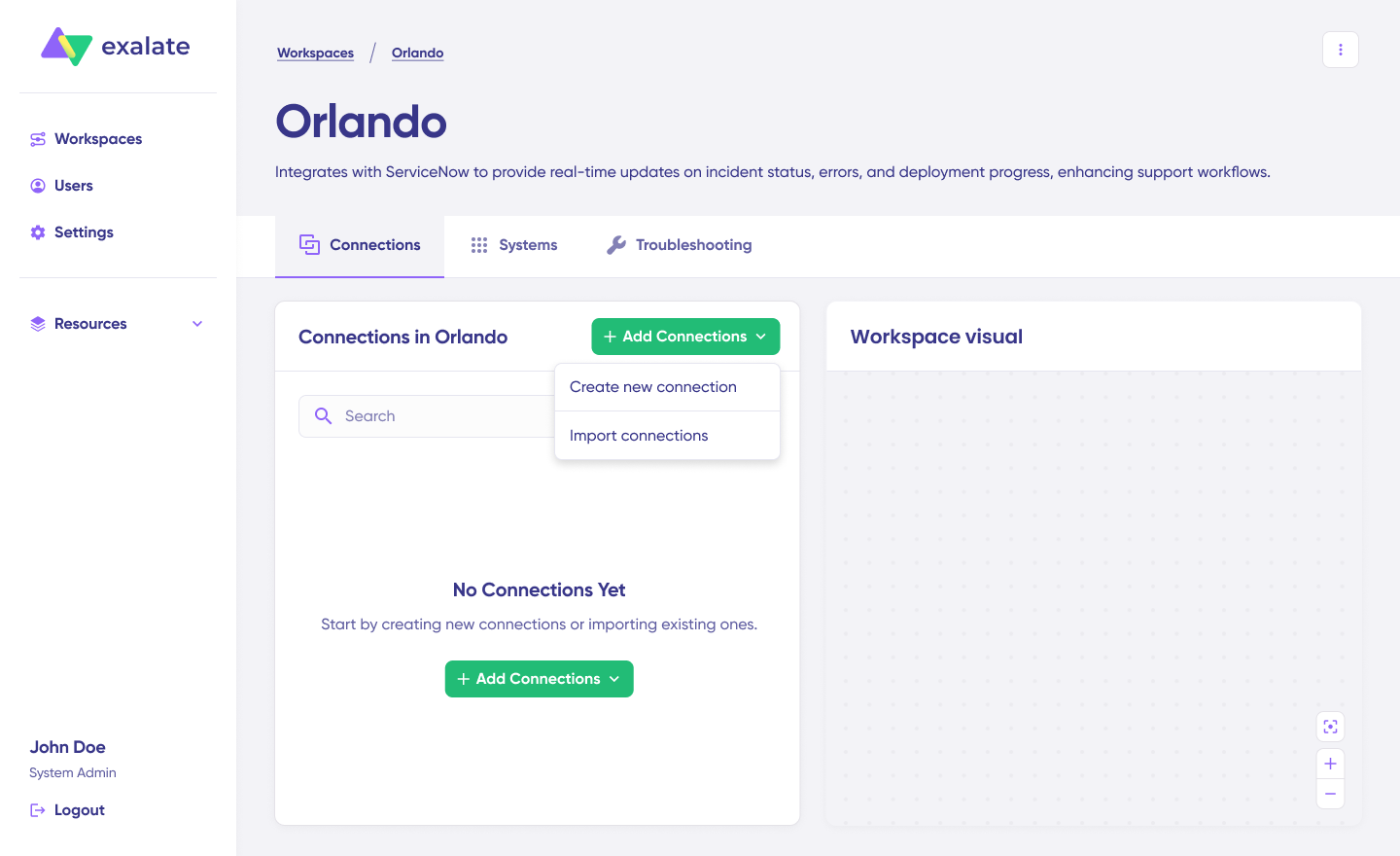
Jira ServiceNow Connection Setup Steps
- Navigate to “+ Add connections” > “Create new connection”.
- Enter “Jira” (or your preferred option) as your first system name. Provide your Jira instance URL.

- Enter the URL of your system. For example, if you start with ServiceNow, enter your ServiceNow instance URL.

- Once you enter the URL, a validation check occurs. If your system is already part of the existing workspace, authentication happens automatically. If the system is part of a different workspace, it will be imported into your current workspace.
- For new systems, you’ll need to enter your authentication details. ServiceNow uses Basic authentication, and Jira uses OAuth.
- Complete the same setup process for the Jira side.
- Give your connection a name and description.

- Click “Next”.
- Review the details to ensure they are correct, then click “Create connection”.
When the process is complete, select “Continue to configuration” and choose a Jira project you want to use for synchronization.
Then click “Build & continue”.
Jira ServiceNow Configuration Options
After creating your connection, you have two configuration options: “Quick Sync” and “Edit & Test”.
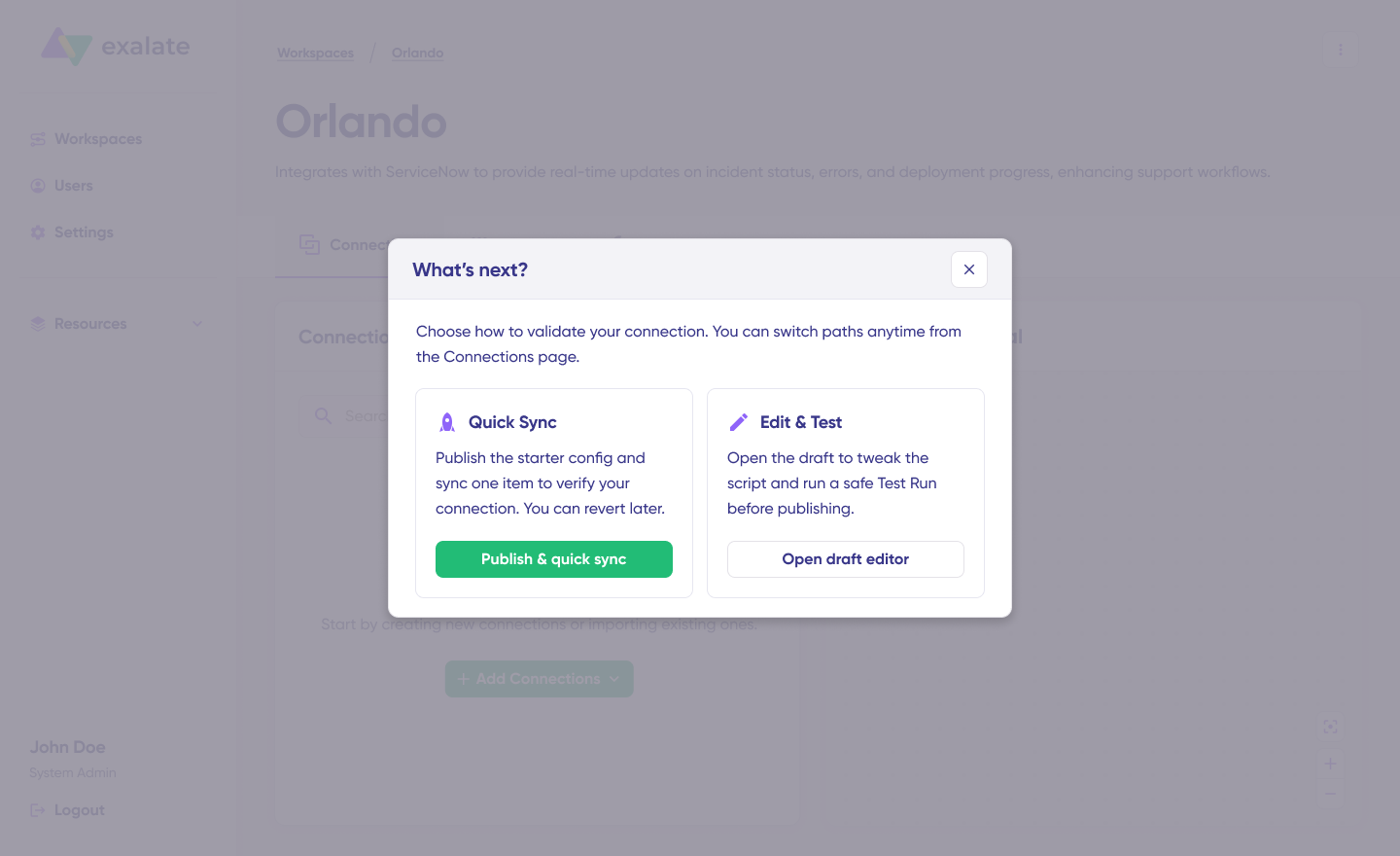
Let’s explore both.
Quick Sync: Publish & Quick Sync
This optional step lets you verify the connection works before diving into advanced configuration.
Under “Item sync monitor,” enter either a Jira work item key (like PROJ-123) or a ServiceNow incident number (like INC0010001).
To sync the first item, click “Sync Now”. To link two existing items, click “Link with existing”.
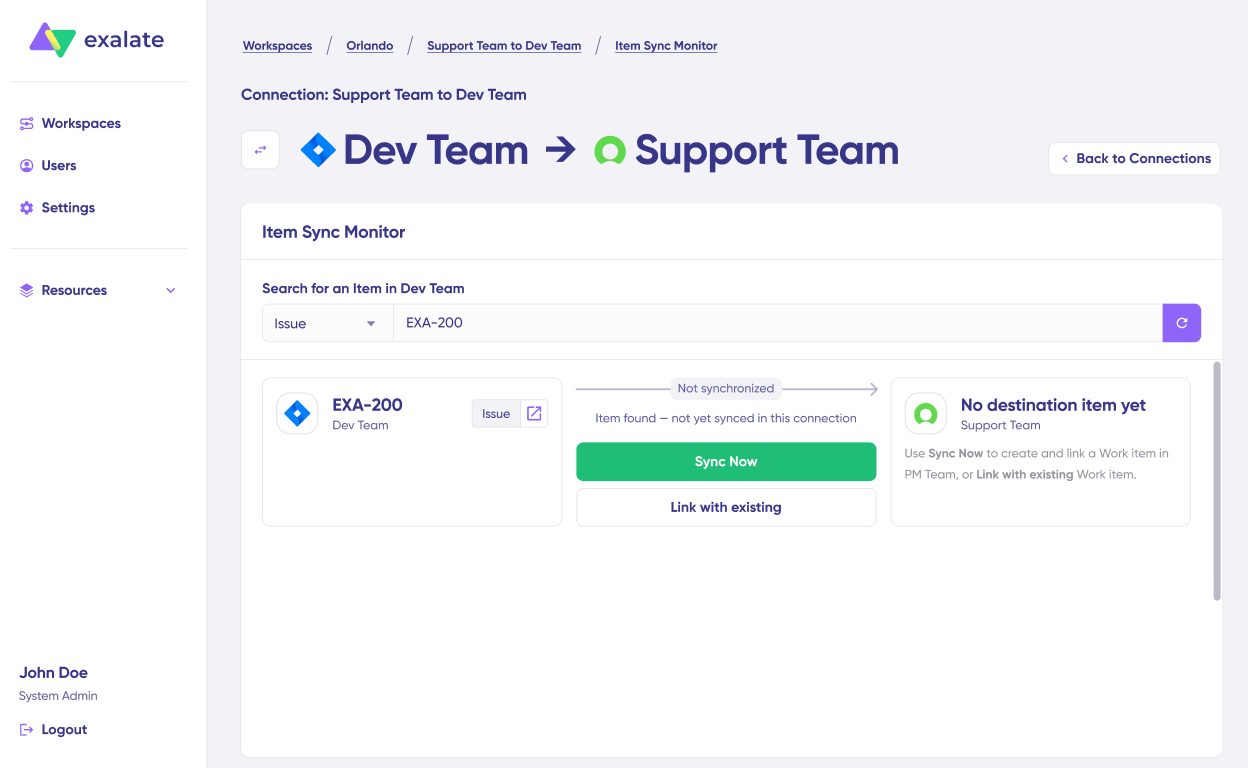
You’ll receive status updates while the items sync, and once the sync is complete, you can view both synced issues by opening them in a new window.

You can also compare how the synced items will look and how the changes will be applied.
Edit & Test: Open Draft Editor
To start making changes to your sync configuration, click “Create a new version” or select “Open latest draft”.
This ensures you don’t accidentally modify the existing configuration. Changes in the draft are saved automatically.
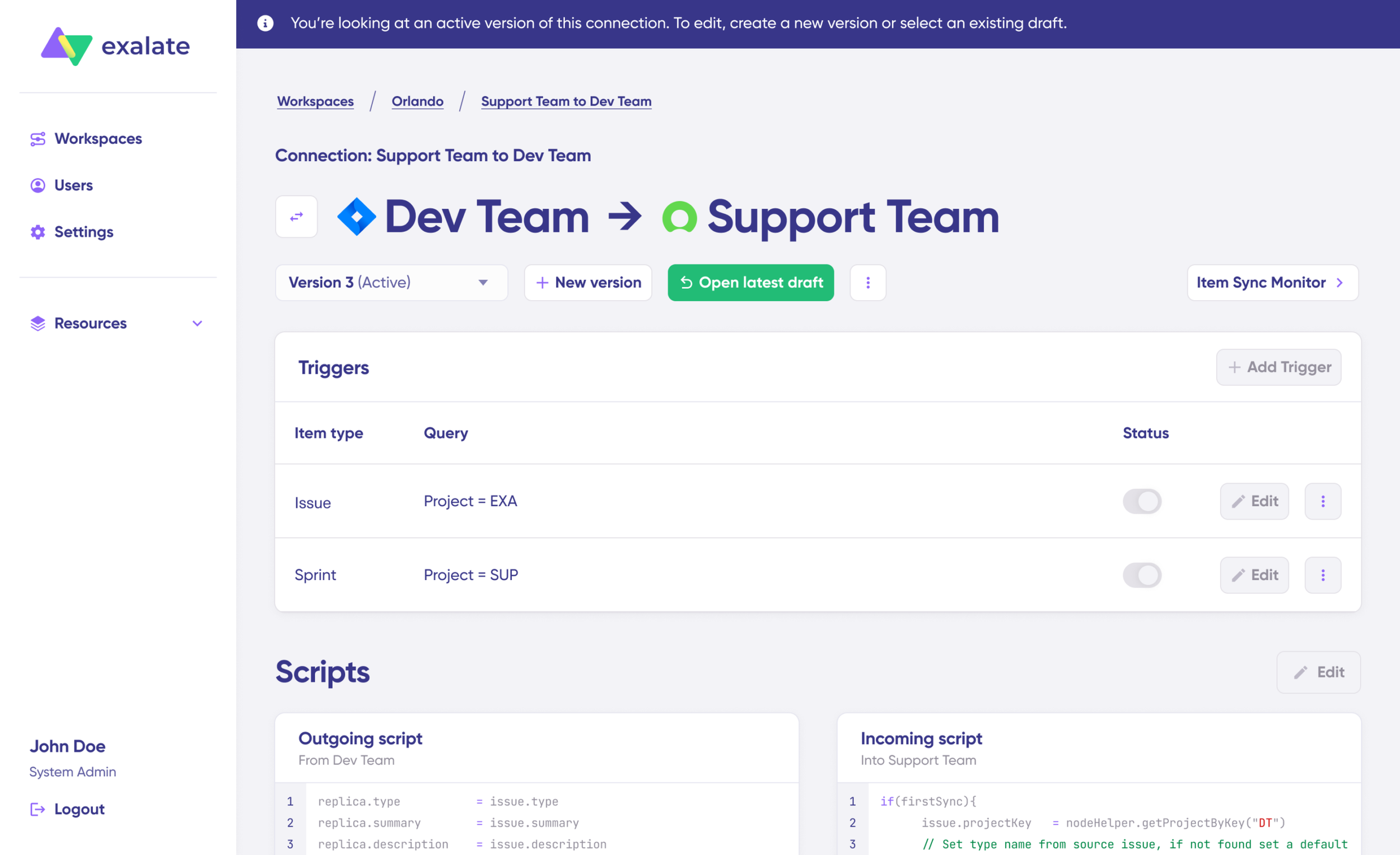
Click the “Edit” button to open the editor and modify the sync rules.
Understanding Sync Rules
Sync rules use Groovy-based scripts that give you complete control over data mapping, conditional logic, and transformation rules. This flexibility accommodates even the most complex integration scenarios.
Direction control: Toggle the sync direction using the arrows next to the connection name.
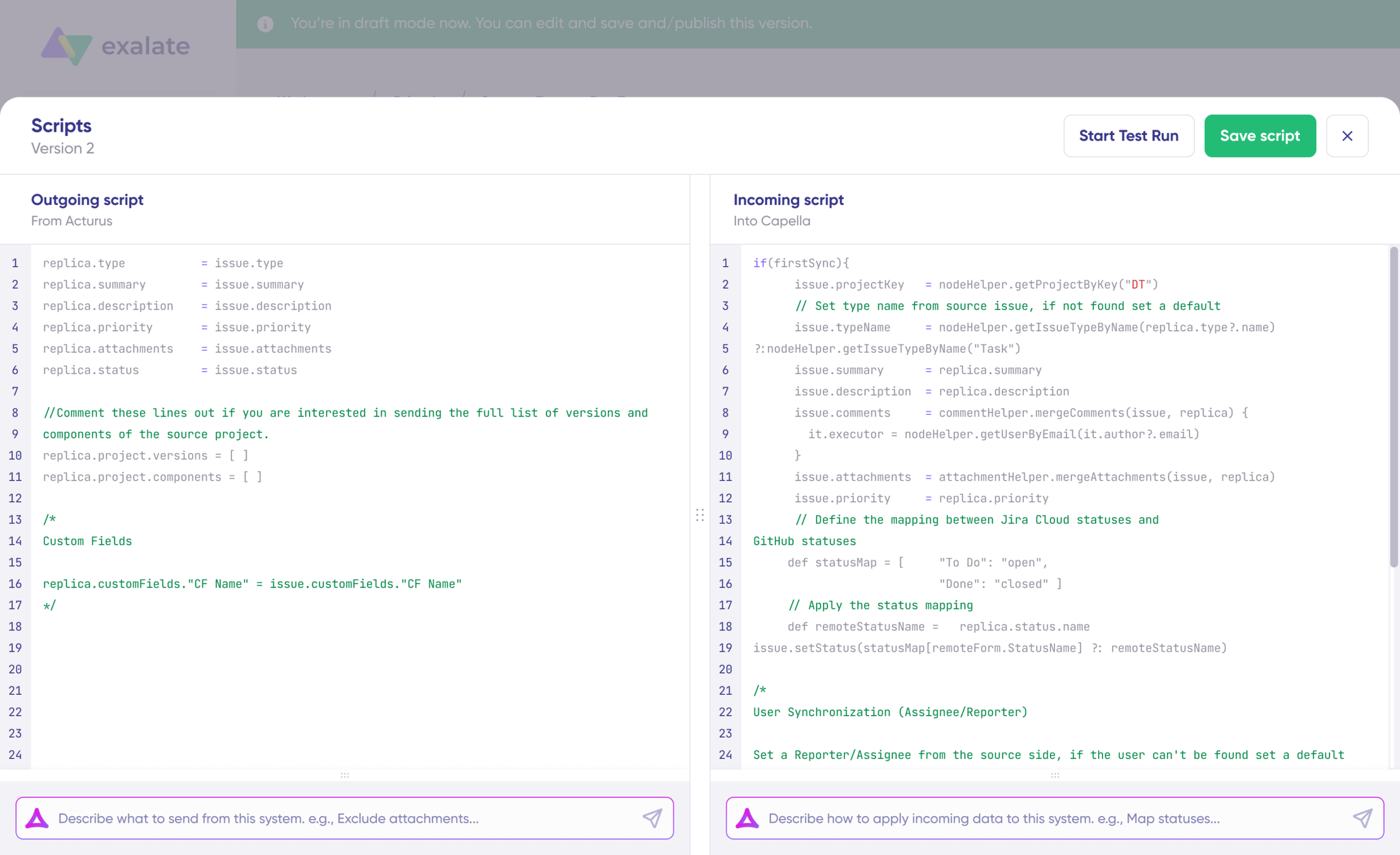
The scripts are divided into incoming and outgoing scripts:
- Outgoing script (Jira side) controls which work item fields—summary, description, priority, status, assignee, comments, attachments—get sent to ServiceNow
- Incoming script (ServiceNow side) determines how those values map to incident fields like short_description, description, urgency, state, assigned_to, work_notes, and attachments
These scripts will be reversed if the direction changes.
Replica works like a message payload and holds the actual data passed between the synced entities. It exists in JSON format.
Common Jira fields in the replica:
- summary, description, status, priority, assignee, reporter
- comments, attachments, labels, components
- custom fields (story points, sprints, epics, etc.)
- work item type, project key
Common ServiceNow fields in the replica:
- short_description, description, state, urgency, priority, impact
- assigned_to, assignment_group, caller_id, category, subcategory
- work_notes, comments, attachments
- incident number, sys_id, opened_at, resolved_at
To sync new values, you can enter the sync script yourself if you are familiar with Groovy.
To stop something from syncing (for instance, attachments from Jira to ServiceNow), simply remove that script line from the corresponding script.
AI-Assisted Configuration
To save time and simplify the scripting process, you can use Exalate’s AI-assisted configuration feature called Aida to generate sync scripts.
Aida is available in both incoming and outgoing script sections, so choose the appropriate side accordingly.
For Outgoing scripts: Describe what data should leave your system.
- “Exclude attachments from sync”
- “Only sync high-priority work items”
- “Send comments but mark them as internal work notes”
- “Include custom field ‘Customer Tier’ in the sync”
For Incoming scripts: Describe how incoming data should map to your system.
- “Map ServiceNow incident states to Jira statuses”
- “Set default assignee when the user doesn’t exist in Jira”
- “Convert ServiceNow urgency and impact to Jira priority”
- “Sync work notes as internal comments”
Based on Exalate’s scripting API and your existing scripts, Aida generates working Groovy scripts with proper field mappings for you.
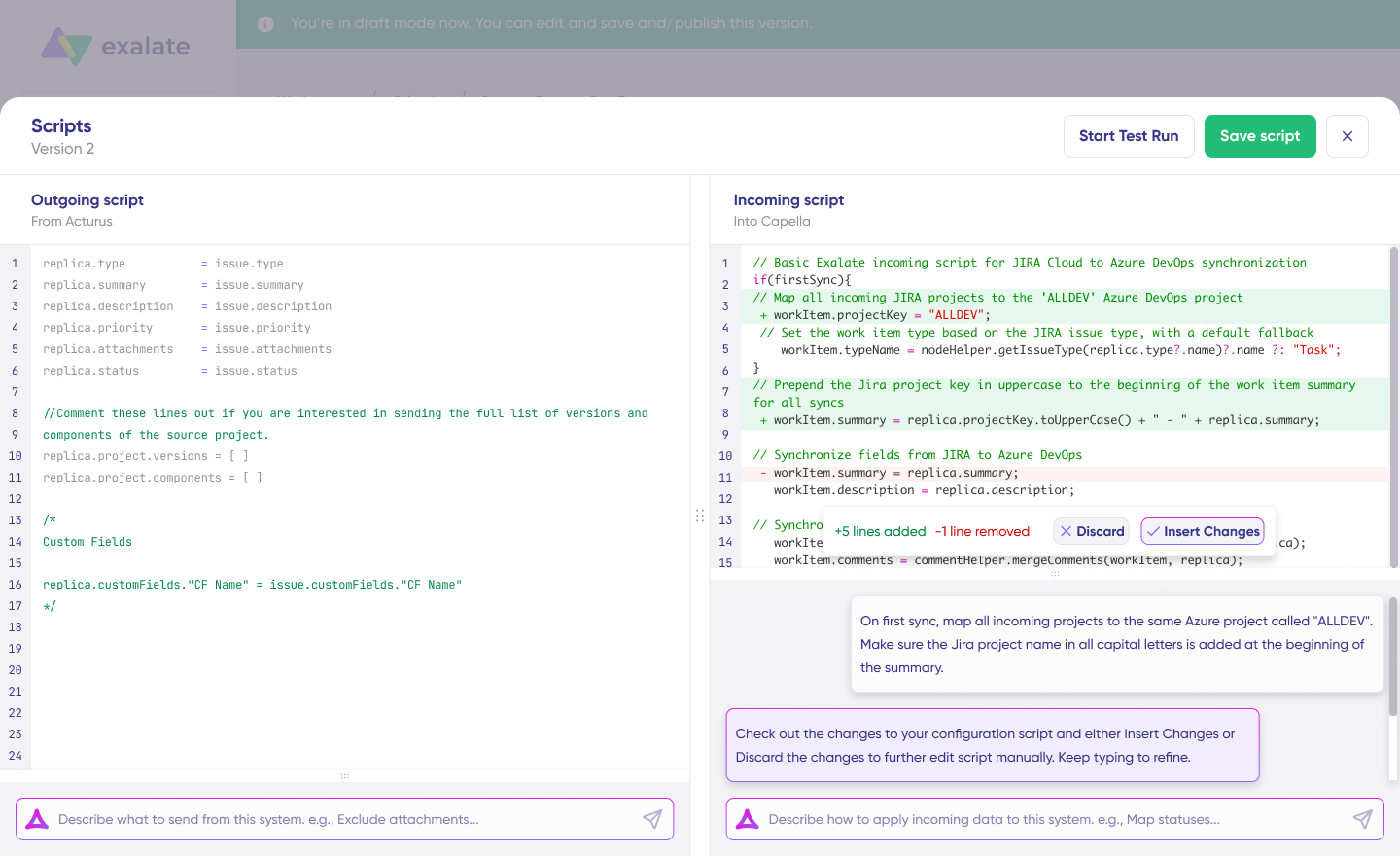
Once Aida finishes drafting your script, review the suggested changes. Green highlights indicate new lines that will be added, while red highlights show lines that will be removed from your script. You can choose to “Insert” or “Discard” Aida’s suggestions.
The outgoing and incoming scripts work independently, as does Aida, so maintain separate context and direction for each prompt.
Note: While Aida is helpful, like any AI tool, please review the generated code before applying it.
TestRun: Validate Before Production
Once your sync scripts are ready, you can choose to “Save script” or proceed to test them using the “Start Test Run” option.
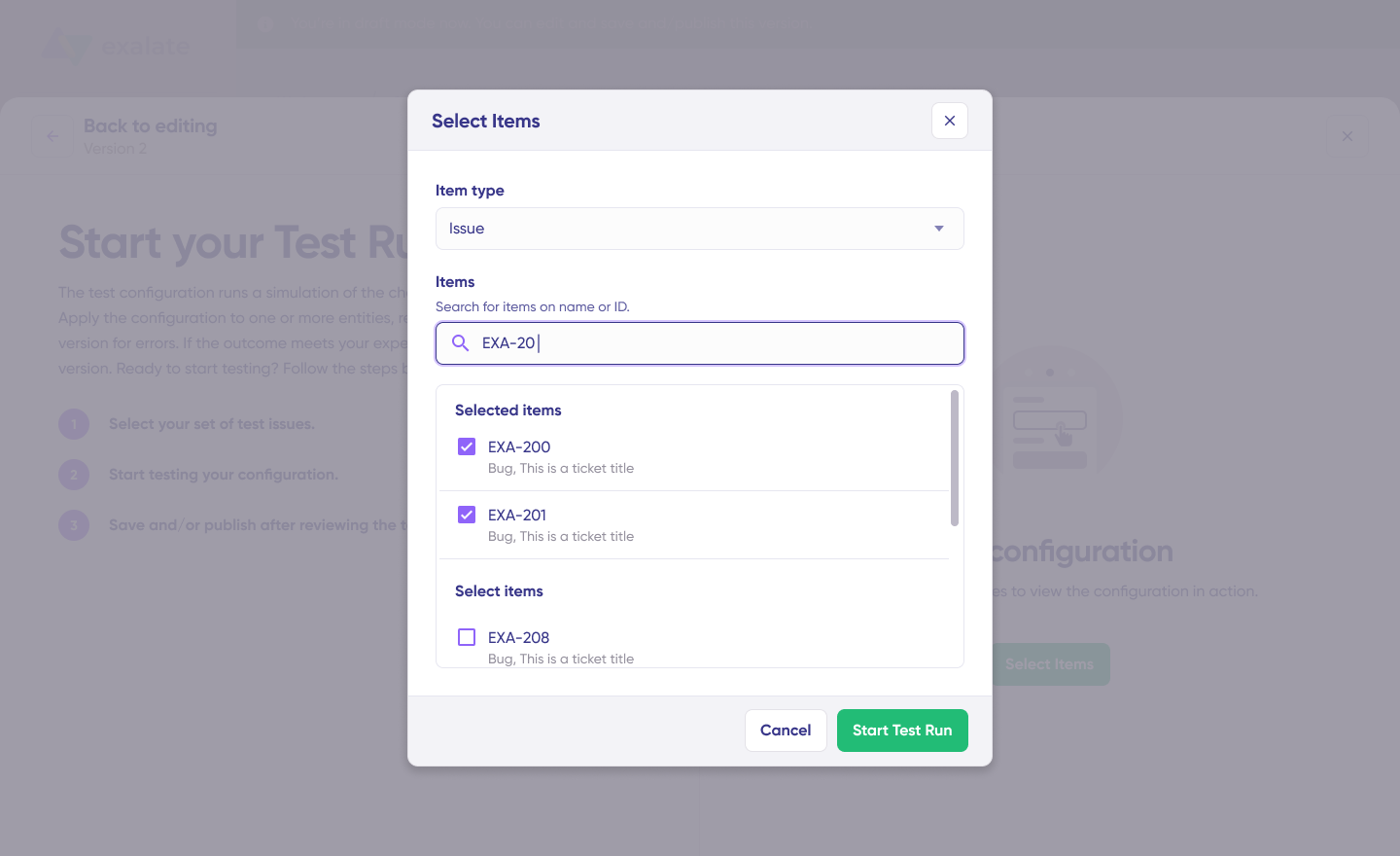
To test the configuration, select the items you want to apply the sync to. You can select multiple items. Once selected, click “Start Test Run”. You can now view all the incoming and outgoing replicas for each item you selected in their respective tabs.

Review how the sync configuration will be applied to your items, preview the replica, and verify that the field mappings look correct. If needed, go back, adjust the scripts, and test again. Deploy only when you’re confident everything works correctly.
This safety net prevents errors from affecting live data.
Once everything matches your needs, click “Publish Version” to apply the updated configuration to your live synchronization.
All versions for a connection are available in the “Version” dropdown. Versions can be either “Active”, in “Draft” (editable), or “Archived”.
Adding Triggers
Triggers automate synchronization based on specific conditions or filters applied to items. Without triggers, you’d need to manually initiate each sync.
Click the “+Add trigger” button to create automation rules.
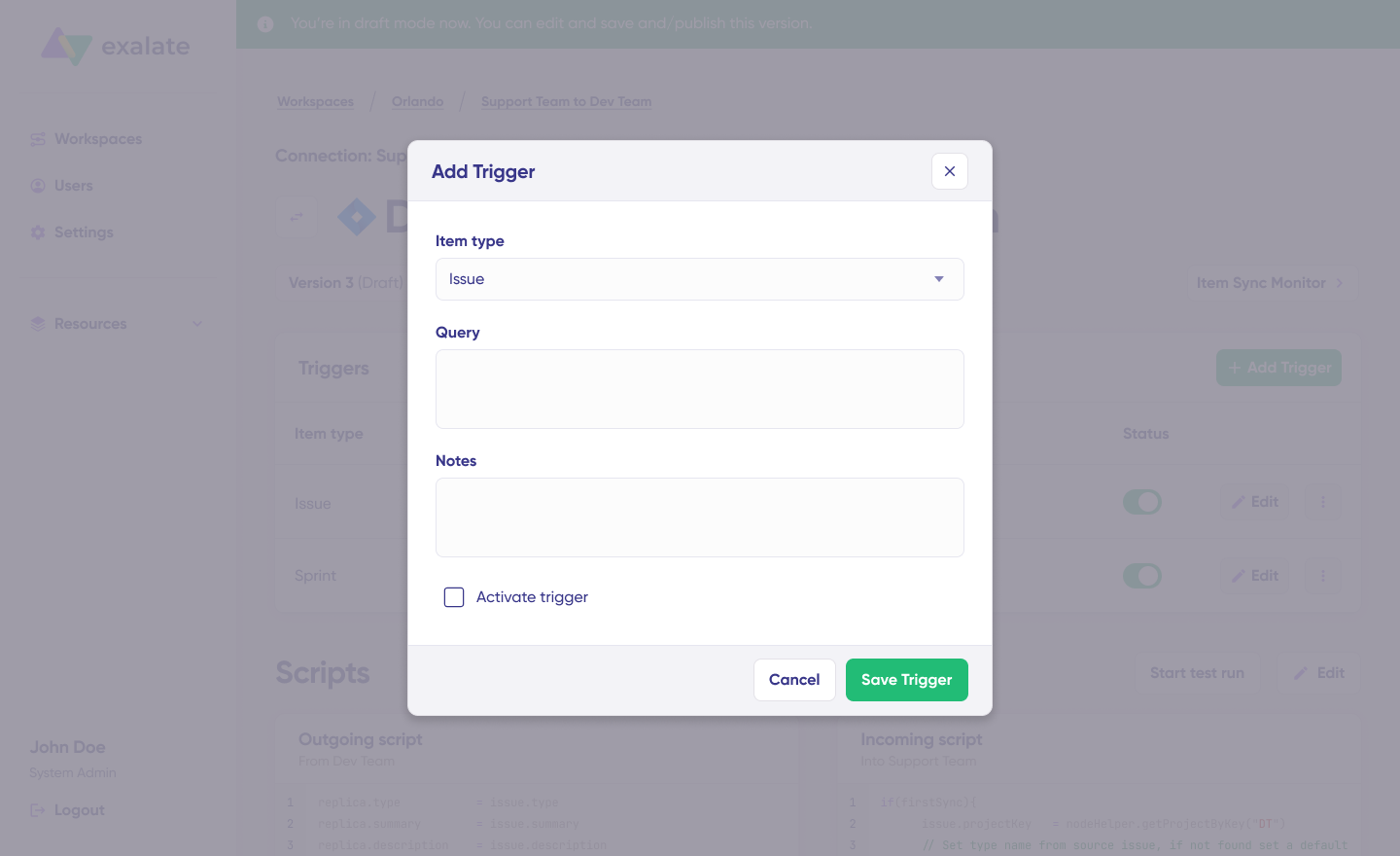
Jira Triggers (JQL Examples)
Use Jira Query Language to define which work items sync automatically:
project = "DEV" AND priority = High– Sync all high-priority work items from the DEV projectlabels = "servicenow-sync"– Sync work items tagged with a specific label- status changed to “Done” – Sync when work items reach completion
ServiceNow Triggers (Advanced Search Syntax Examples)
Use ServiceNow’s advanced search syntax to target specific entities:
assignment_group=Development AND priority=1– Sync critical incidents assigned to developmentsys_created_on>=javascript:gs.beginningOfToday()– Sync incidents created todaytype=incident OR type=change_request– Sync both incidents and change requests
Save and publish your trigger configuration to activate automatic synchronization.
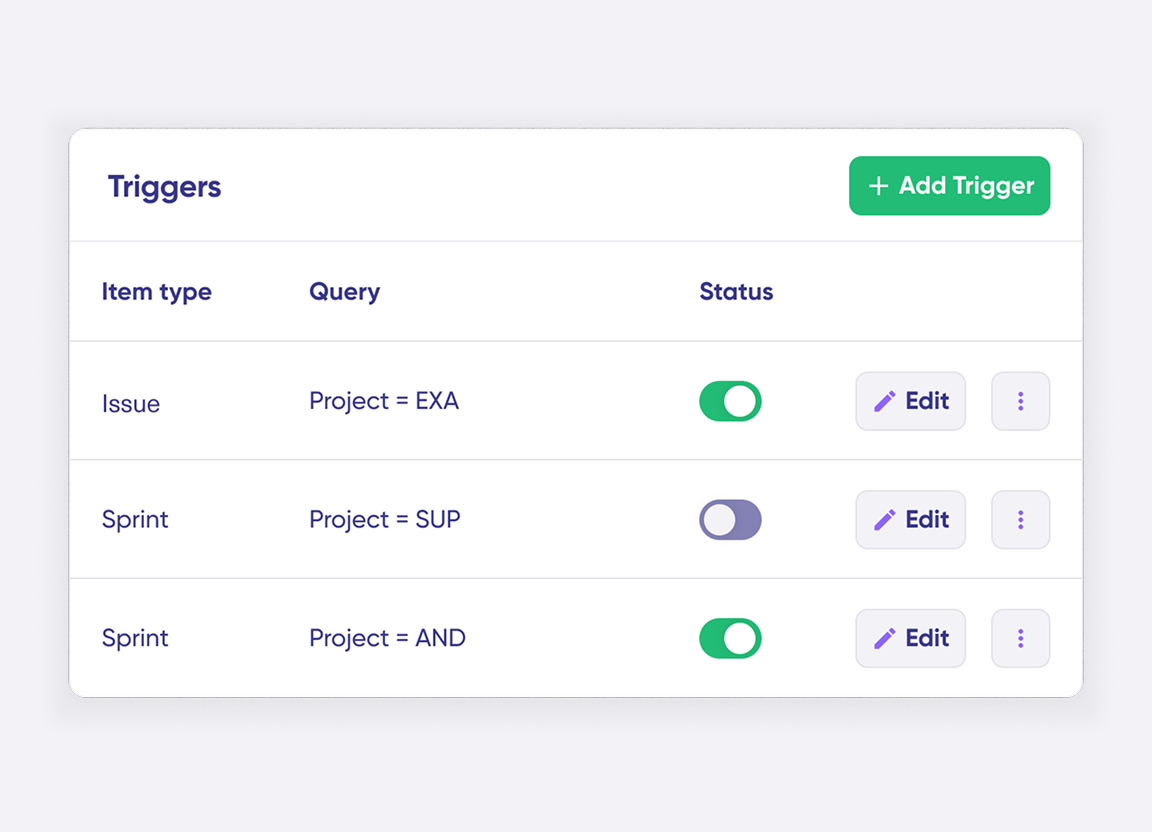
Save your changes by publishing them.
Troubleshooting with Aida
Aida helps you troubleshoot errors faster by offering clear and context-aware suggestions to resolve errors right where you see them.
If there’s an error, go to the “Troubleshooting” tab of your workspace. Hover over the error you want to diagnose and click on the Aida icon that appears next to the error. You will see the AI-generated suggestion in the modal window. This includes a short explanation of the error and a proposed solution for it.
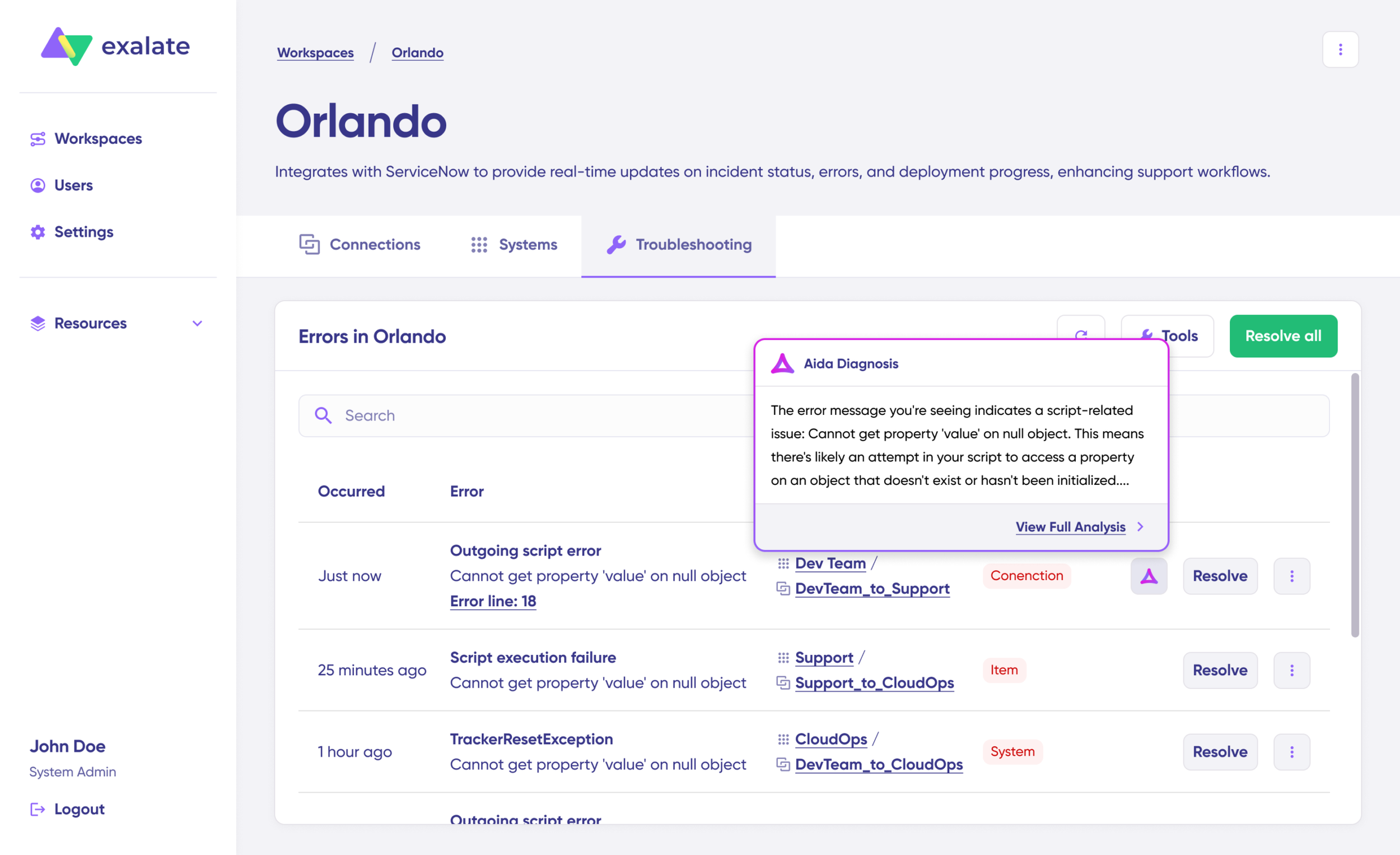
You can also “View Full Analysis” to get more context.
Additionally, you can view “Error details” to copy the stack trace and “Replicas” to view the JSON format, if required.
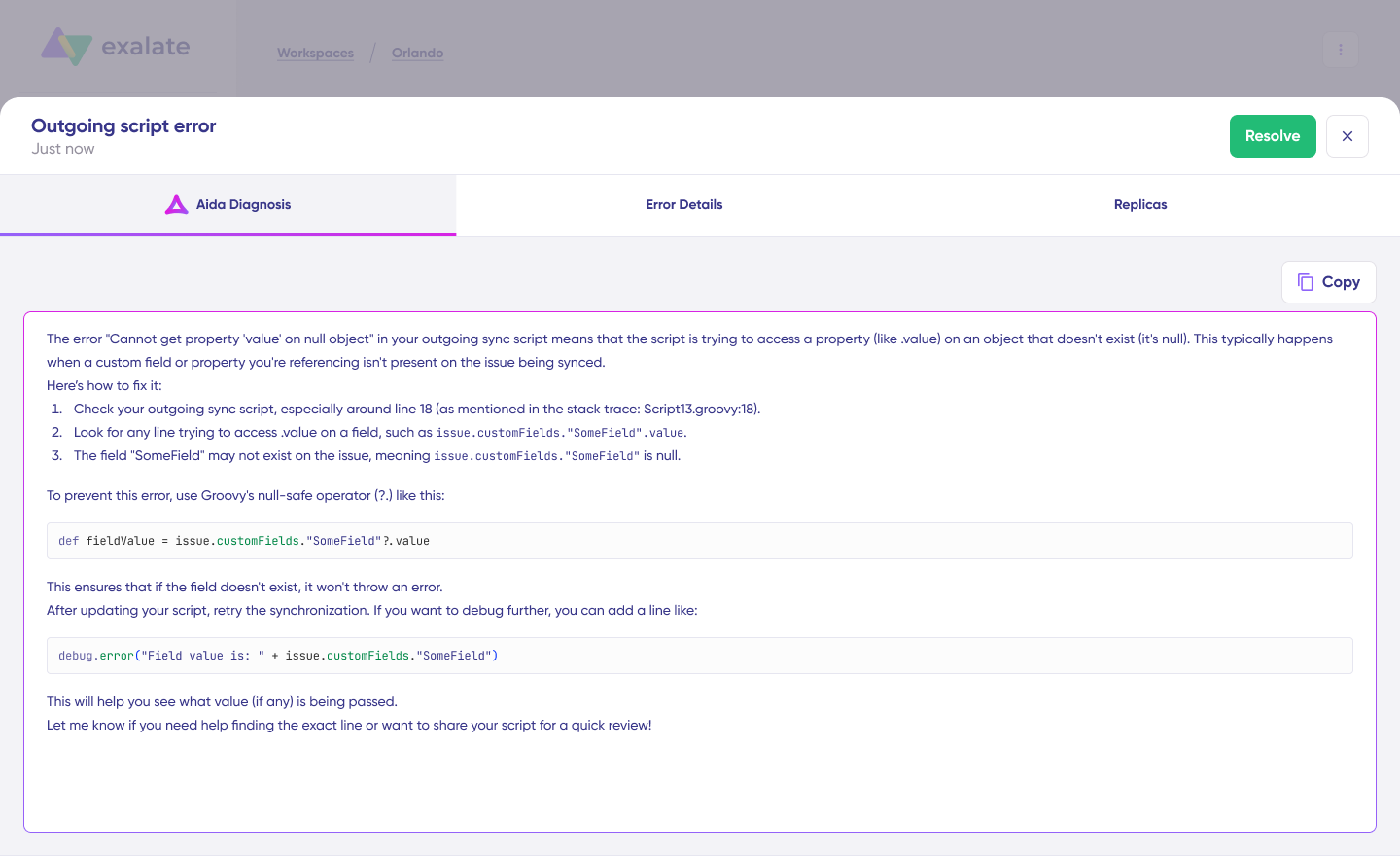
Choose to “Resolve” and retry errors as needed.
Use Cases for AI in Jira ServiceNow Integration
Use Case 1: Map ServiceNow Incident Priority to Jira Work Item Priority
Challenge: Support teams need ServiceNow incident priorities reflected accurately in Jira work items, but the priority scales don’t match directly.
Solution: AI-assisted configuration maps priority values with custom logic.
The prompt specifies exact mappings:
“Define the ServiceNow incident priority as the Jira work item priority such that ‘1-Critical’ and ‘2-High’ appear as ‘High’, ‘3-Moderate’ is ‘Medium’, ‘4-Low’ is ‘Low’, ‘5-Planning’ is ‘Lowest’, and the default priority is ‘Low'”
Real-World Application: An MSP receives incidents from clients in ServiceNow. When escalating to development teams in Jira, priorities translate automatically. Critical production outages (Priority 1) become High-priority work items, ensuring developers understand urgency without manual interpretation.
Use Case 2: Automate Work Item Creation Using Jira Labels
Challenge: Support teams track everything in Jira, but contractual requirements mandate certain issues be documented in ServiceNow.
Solution: Trigger-based automation creates ServiceNow incidents when specific labels are added to Jira work items.
Real-World Application: A support agent adds the label “requires-servicenow” to a Jira work item. Exalate automatically creates a corresponding ServiceNow incident with all relevant details. The support agent never leaves Jira; compliance requirements are met automatically.
Use Case 3: Sync SLA Records from ServiceNow to Jira
Challenge: Developers working on ServiceNow incidents need visibility into SLA constraints without leaving Jira.
Solution: When an SLA record is created or updated in ServiceNow, it automatically syncs to a custom field in the linked Jira work item.
Real-World Application: A Priority 1 incident is raised and assigned to the development team. Along with the incident details, SLA information syncs to Jira. Developers see the countdown timer and breach deadlines directly in their workflow, eliminating the need to check ServiceNow for time constraints.
Use Case 4: Convert ServiceNow Incidents to Jira Epics with Story Breakdown
Challenge: Complex incidents require multiple development tasks. ServiceNow tracks the incident; Jira needs to track the work breakdown.
Solution: AI-assisted configuration creates a Jira Epic from the ServiceNow incident, allowing developers to break it into stories. Time tracking from Jira stories aggregates back to the ServiceNow incident.
Real-World Application: A major system outage creates a ServiceNow incident. The development team creates an Epic in Jira, breaks it into five stories (database fix, API update, cache clear, testing, documentation), and tracks time on each. Total time spent syncs back to ServiceNow for SLA reporting and billing.
Use Case 5: Bidirectional Status Sync for MSP Operations
Challenge: MSPs use ServiceNow internally, but clients use Jira Service Management. Status updates must flow in both directions without manual intervention.
Solution: AI generates bidirectional status mapping scripts. Define which ServiceNow statuses correspond to which Jira statuses.
Sample prompt: “I want the status of the Jira Service Management work item to display ‘New’ when the ServiceNow incident status is ‘Open’. The Jira work item should show ‘Done’ when ServiceNow status is ‘Resolved’.”
Real-World Application: An MSP’s support agents update incident status in ServiceNow. Clients see corresponding status changes in their JSM portal automatically. When clients close tickets in JSM, ServiceNow incidents update to Resolved. Neither team needs to check the other system.
Best Practices for AI-Powered Integration
- Consult both teams: Ensure ServiceNow and Jira administrators agree on data sharing scope and sync behavior before configuration.
- Start specific: Begin prompts with exact field names and expected values. “Sync the priority field” is weaker than “Map ServiceNow incident priority values 1-5 to Jira work item priority values Critical, High, Medium, Low, Lowest.”
- Save effective prompts: Build a library of prompts that produce accurate results. Reuse them for similar configurations.
- Test incrementally: Validate each sync rule independently before combining into complex workflows.
- Document exceptions: Record edge cases where AI output required manual adjustment. These inform future prompts.
- Maintain full script control: Retain the ability to modify and override AI-generated scripts. You need operational control over your sync side for troubleshooting and compliance.
How Exalate Enables AI-Powered Integration
Exalate connects Jira and ServiceNow with AI-assisted configuration capabilities. It also supports integrations with Azure DevOps, Azure DevOps Server, GitHub, Zendesk, Salesforce, Freshservice, Freshdesk, and Asana.
Aida – Scripting Assistant
Aida Exalate’s AI-assisted configuration is embedded directly in the scripting console. It considers your existing sync rules when generating suggestions and retrieves information instantly. Instead of searching through pages, prompt Aida with your question and get relevant answers with code examples.
Aida helps with:
- Finding configuration syntax for specific use cases
- Understanding field mapping options
- Troubleshooting sync errors
- Learning best practices for complex scenarios
The AI generates output with visual diff highlighting:
- Green highlights show suggested additions
- Red highlights show suggested deletions
Review the output, accept changes that meet your requirements, and refine your prompt for anything that needs adjustment.
Conclusion
AI-powered Jira ServiceNow integration reduces the scripting burden without sacrificing flexibility. Describe your sync requirements in plain language; AI generates working Groovy scripts in seconds.
The key is treating AI output as a starting point, not a final product. Review generated scripts, test in development environments, and refine prompts until output matches your requirements. For complex use cases involving multiple platforms, custom field mappings, or cross-company data sharing, book a demo to see how Exalate’s AI-assisted configuration handles your specific scenarios.
Frequently Asked Questions
What data can I sync between Jira and ServiceNow using AI-assisted configuration?
You can sync any entity available through both platforms’ APIs: incidents, change requests, problems, CMDB items, work items, epics, stories, comments, attachments, custom fields, statuses, priorities, SLA records, and more. AI-assisted configuration generates the scripts; you control what data flows.
How accurate are AI-generated sync scripts?
Accuracy depends on prompt specificity. Well-crafted prompts with exact field names, data types, and expected behavior produce highly accurate scripts. Generic prompts produce generic results. Always test AI output in a development environment before production deployment.
Can I modify AI-generated scripts?
Yes. AI output serves as a starting point. You have full script control to modify, extend, or override any generated code. This ensures you maintain operational control over your sync configuration.
What happens if the AI generates incorrect code?
Refine your prompt and regenerate. If the issue persists, fall back to manual scripting using Exalate’s documentation and script helpers. Aida can also help troubleshoot specific syntax questions.
Is my data secure when using AI-assisted integration?
Exalate maintains ISO 27001 certification, encrypts data in transit and at rest, and implements role-based access control. AI features process prompts and generate scripts without exposing your sync data to external systems. Review the Trust Center for detailed security documentation.
Can non-technical users set up integrations with AI assistance?
Yes. Aida accepts natural language descriptions of sync requirements. Non-technical users can describe what they need (“sync high-priority incidents to our engineering project”) and receive a working configuration. Technical users can then refine the generated scripts for edge cases.
What other platforms does Exalate support beyond Jira and ServiceNow?
Exalate connects with Azure DevOps, Azure DevOps Server, GitHub, Zendesk, Salesforce, Freshservice, Freshdesk, and Asana. Custom connectors are available for proprietary systems with REST APIs.
How does Aida differ from AI-assisted configuration?
Aida is a scripting assistant that answers questions about Exalate features, syntax, and best practices. It is embedded in the scripting console and generates actual sync scripts based on your prompts and existing configuration context.
Recommended Reading:
- Jira ServiceNow Integration: How to Connect Jira and ServiceNow in 6 Steps
- AI-Powered Integration: The Future of Business Connectivity
- How to Sync Incidents, CMDB, Change Requests, Problems, and Custom Fields Between Jira and ServiceNow
- How to Sync SLA Records and Maintain State Updates From ServiceNow Incident to Jira Issue
- How to Sync Jira Issue Fields as Work Notes in ServiceNow
- How to Sync Time-related Information between ServiceNow and Jira